

What is endpoint security, once the definition is settled, is a decision about whether the controls you already run are enough. A mature IT team usually has agents, a console, and a patch cycle. The harder question is whether those controls still match the devices that hold identity and data, and whether a named person can act when one of them fails. This guide is for directors and CISOs who need that call, not another product tour.
Schedule a security risk assessment when you need an outside view of whether current endpoint controls still match the devices and response duties you own.
If you need the foundation first, read the BCS365 guide to what endpoint security is. That page covers the definition, the device classes, the control layers, and how a program is built. This article does not repeat that map. It gives you five questions, the evidence each one should produce, and a clear point at which endpoint controls stop being enough on their own.
What is endpoint security when the definition is already known?
For a director who already runs a program, what is endpoint security is the operating claim you are willing to make. The claim has three parts. You know which devices access identity and data. A current control sits on each in-scope device, or an exception says why it cannot. Someone owns the alert and can contain the device.
NIST's glossary defines an endpoint as any device used to access a digital identity on a network. The list includes laptops, desktops, phones, tablets, servers, IoT devices, and virtual environments. NIST's endpoint protection platform definition, drawn from SP 800-128, describes software safeguards on end-user machines, such as antivirus, a personal firewall, and host-based intrusion prevention. Those two lines set the floor. They do not tell you whether your floor still holds.
The useful test is narrower than a feature list. Can you show, for a named device class, that the control is installed, current, and tied to a response owner? If you cannot, the program is a deployment, not a decision. Deployment only answers whether the tool was purchased. The decision answers whether you can rely on it this quarter.
Summary: Once the definition is known, endpoint security is a claim you can stand behind. In-scope devices need a current control and a named response owner.
Which questions should a director ask first?
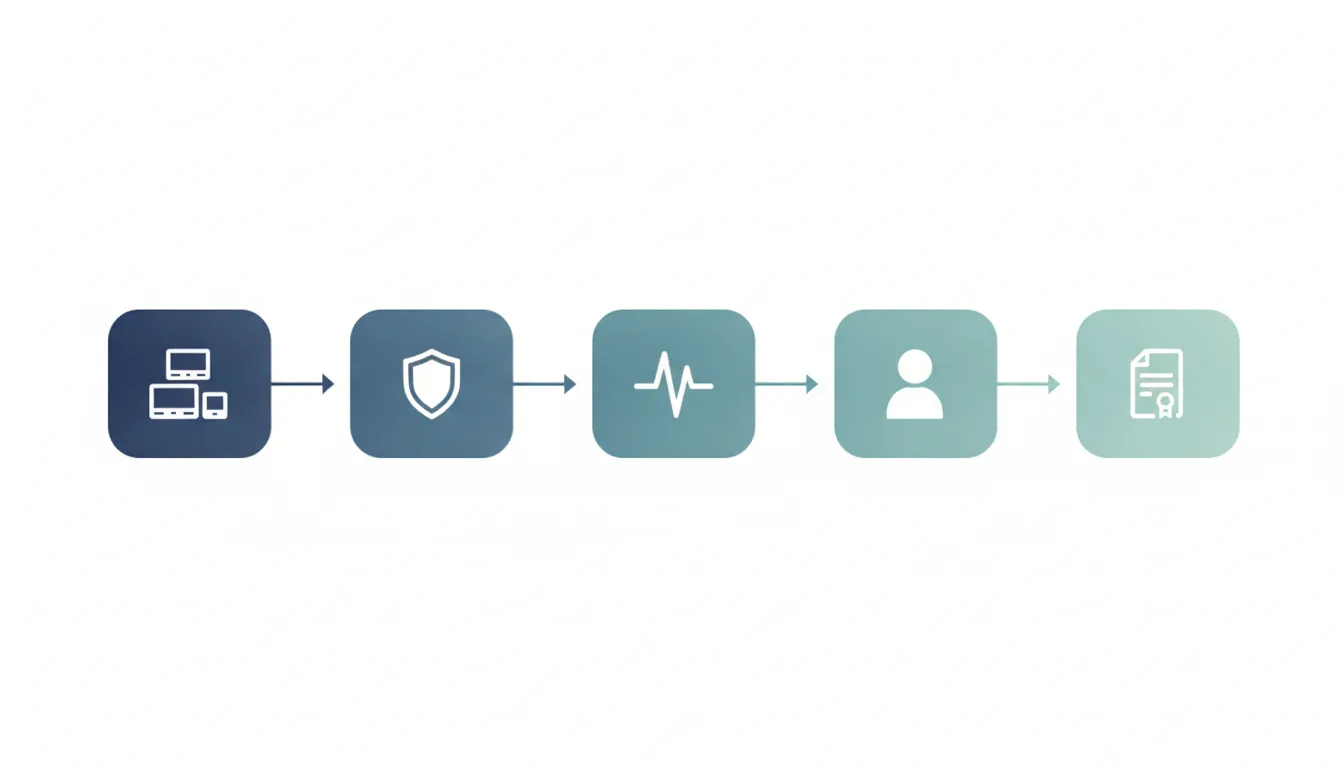
Five questions separate a program you can defend from a console you can demo. Ask them in order. A later yes does not repair an earlier no.
- Is the inventory the same list security and IT both trust? If servers, virtual machines, or contractor devices sit on a second list, the coverage number is a slice, not the estate.
- Does every in-scope class have a current control or a written exception? An exception with an owner and an expiry is a control. A silent miss is a gap.
- Can you show health, not just install? Health means a recent check-in, the current policy, and the required modules present. Install means the agent was there once.
- Does each alert class have a named owner and a tested containment path? An alert with no owner is noise. A path that has never been run is a hope.
- Can you show the same evidence to an auditor and to your own leadership? If the audit pack and the operating pack are different documents, the program is still being translated by hand.
Stop at the first no. That is the decision, and it is more useful than a blended score. A team that fails question three does not need a new product category yet. It needs a health standard. A team that passes the first four and fails the fifth needs an evidence pack, not another agent.
Run the questions on one class at a time. Windows laptops, Windows servers, virtual machines, and contractor devices rarely fail in the same place. A laptop fleet can look healthy while servers miss the current policy, or while contractor devices never entered the inventory security trusts. Mixing those classes into one percentage hides the class a director can actually assign.
Give each question an owner before the meeting. IT owns the inventory and the exception list. Security owns health exports and the alert path. The director owns the call on whether the two packs match. A question with no owner becomes a discussion. A question with an owner becomes a date.
Keep the pass bar written down. For health, name the check-in window, the policy version, and the modules that must be present. For response, name the person and the containment step that has been run on a real or tabletop host. For evidence, name the single pack both the auditor and the leadership team will see. Vague bars produce vague greens.
Summary: Ask about inventory, control or exception, health, response ownership, and evidence. Take one device class at a time, and stop at the first no.
How do you tell a healthy control from an installed one?
Install rate is the number leaders are handed because it is easy to export. It is also the number that hides the decision. A device can carry an agent and still miss the policy, the module, or the check-in window you set. Treat health as three facts you can pull without a special project.
| What you can show | What it actually proves | Decision it supports |
|---|---|---|
| Agent installed. | The software was deployed at least once. | Not enough to claim coverage. |
| Recent check-in, current policy, and required modules enabled. | The control is running the standard you approved. | Enough to call that device healthy. |
| Written exception with owner and expiry. | An uncovered device is a managed choice. | Accept, compensate, or plan a date. |
| Named alert owner and a tested containment step. | A failure can be acted on, not only seen. | Enough to claim response, not only detection. |
| One evidence pack for audit and for leadership. | The operating story and the audit story match. | Enough to brief without a side project. |
Read the table from top to bottom. The first row is what most dashboards lead with, and it is the only row that does not support a decision. The second row is the minimum bar for healthy. The third row keeps exceptions from turning into folklore. The fourth row is where many mid-market programs stall: the control reports, and nobody has practiced containment. The fifth row is how you know the program can survive a board question and an audit request in the same week.
Pull one device class, such as Windows servers or contractor laptops, and fill the rows with live exports. If a row needs a manual spreadsheet, that row is the gap. Do not average it into a percentage.
Summary: A healthy control shows a recent check-in, the current policy, and the required modules enabled. An install rate by itself does not show that.
When is endpoint security not enough on its own?
Endpoint controls are enough when the five questions pass for the classes that hold identity and data, and when your own team can keep that evidence current. They are not enough when any of these are true.
- Alerts queue overnight or over a weekend because nobody is assigned after hours.
- The people who can contain a host are the same people running projects, so response waits on a calendar.
- A regulator, customer, or insurer wants proof of monitoring and response, and the proof takes a project to assemble.
- New sites, acquisitions, or contractor populations keep arriving faster than the exception list is updated.
That is the point where a force multiplier helps a mature internal team, rather than replacing it. Managed Detection and Response (MDR) adds continuous monitoring and a response path your staff does not have to staff alone. It does not replace the inventory, the exception list, or the decision about which devices are in scope. Those stay with you.
Use a short test before you change the operating model. Pick the last five endpoint alerts that mattered. For each one, write who saw it, how long it waited, and whether containment was run. If two or more waited because the owner was off shift or in a project, the control is detecting and the program is not responding. That record is the brief for Managed Detection and Response (MDR). A vendor slide is not.
Regulated teams hit a second version of the same gap. A customer, insurer, or examiner asks for proof that monitoring ran and that response had an owner. If building that proof takes a fresh export project, the program cannot show what it claims to do. Evidence is easier to defend when the weekly operating pack and the audit pack are the same file. U.S.-based analysts who already know the estate can keep that file current without taking the internal team off its own work.
The BCS365 EDR and antivirus comparison covers which control belongs on the host. The guide to outsourcing endpoint monitoring covers operating models. Use those when the question is product or sourcing. Use this page when the question is whether the program you have is enough.
Summary: Endpoint security is not enough when after-hours response, evidence, or new populations outrun the team. The team that owns the controls has to be able to keep up.
What should the decision produce?
A review that ends in a slide has not finished. Each in-scope class should leave the review with one outcome: restore the control, compensate for it, or accept the exception in writing. Restore means the health row is true. Compensate means a second control covers the same risk until the primary is fixed. Accept means an owner, a reason, and an expiry date are on the record.
Write the outcome where both IT and security can see it. Tie it to the asset class, not to a tool name. Then decide the operating model in one line. Keep response inside the team when the five questions pass. Add Managed Detection and Response (MDR) for the hours and the evidence you cannot staff. Book a security risk assessment when you do not yet trust the inventory the decision depends on.
Two neighboring pages stay out of this decision. Endpoint management technology is about device administration, patching, and access, not about whether the security control is healthy. Next-gen endpoint protection is about product architecture. Link them when a reader needs that depth. Do not fold them into this call.
Directors in life sciences, finance, manufacturing, and other regulated mid-market teams feel this most when an audit asks for the same evidence the security lead uses on a normal week. If those two packs differ, fix the pack before you add tools. The cybersecurity practice is the right next conversation when the decision is to add people and process, not another agent.
Put the outcome in a register the next review can reopen. Columns that earn their keep are the device class, the failed question, the chosen outcome, the owner, and the review date. Leave tool names out of the outcome column. A restored server class should still say restored after you change agents. An accepted contractor-laptop exception should show its expiry without a hunt through email.
Then name the operating model in the same register, in one line. Use "internal team, business hours" when the five questions pass. Use Managed Detection and Response (MDR) for after-hours containment and the evidence pack when question four or question five fails. Use a security risk assessment before any new control when question one fails. A line you cannot write means the review is not done.
Review the register when the estate changes, not only on a calendar. A new site, an acquired domain, or a contractor wave can pass last quarter's bar and fail this quarter's inventory. The decision guide stays useful only if the register is the record you brief from.
Summary: Every in-scope class should be restored, compensated, or formally accepted. Name the operating model in one line on a register you can reopen.
What should you do with the answer?
If the first four questions pass and the evidence pack matches, keep the program and review it on a set cadence. If health or exceptions fail, fix that class before you buy a new layer. If response ownership or audit evidence fails, that is the brief for Managed Detection and Response (MDR) or for a security risk assessment, not for another definition of the term.
BCS365 works as a force multiplier for internal IT teams that already have a program and need the coverage, the after-hours response, or the evidence to match it. The work is consultative: confirm the inventory, test the health claim, and leave you with outcomes you can assign. It is not a replacement for the team that owns the devices.
Book a security risk assessment to test these five questions against your live inventory and decide where endpoint security still carries the risk.
FAQ
What is endpoint security in practical terms?
Endpoint security is the set of controls and ownership that keep devices accessing your network inside a current standard. The practical test is health plus a named response owner, not a feature list.
How is this different from antivirus?
Antivirus is one safeguard inside an endpoint protection platform. Endpoint security, as an operating decision, also includes which devices are in scope, whether the control is healthy, and who contains a failure. The live comparison of EDR and antivirus covers the product side.
When should we add Managed Detection and Response (MDR)?
Add Managed Detection and Response (MDR) when your own team cannot staff after-hours monitoring or cannot produce response evidence without a special project. Do not add it to hide an inventory you do not trust. Fix the inventory first.
How often should directors revisit this decision?
Revisit it when the estate changes: a new site, an acquisition, a contractor wave, or a control that misses its health standard. A quarterly pass on the five questions is enough for a stable estate. A trigger-based pass is required when the population shifts.