

Endpoint protection is often treated as a product choice, but the more important question is what each control can actually see. Traditional antivirus remains useful for identifying known malicious files and preventing or containing malware incidents. It becomes less decisive when an attacker uses legitimate system tools, novel malware, or activity that looks benign in isolation.
EDR vs antivirus is primarily a difference between behavioral visibility and signature-based prevention. Antivirus checks files and other indicators against known threats, while Endpoint Detection and Response (EDR) continuously collects endpoint telemetry to identify suspicious behavior, investigate activity, and support containment. Mid-market organizations generally need both layers, with EDR adding depth rather than replacing baseline protection.
Ready to assess your endpoint security posture? Schedule a Security Risk Assessment to identify gaps in your current detection and response capabilities.
That distinction starts with understanding the role antivirus was designed to play. NIST defines antivirus software as a program that monitors a computer or network to identify major malware types and prevent or contain incidents. Its strengths and boundaries become clearer when that function is examined on its own.
What Does Traditional Antivirus Actually Do?
Traditional antivirus (AV) is primarily a preventive control that examines files, programs, and other activity against known indicators of malicious code. Its core operating model is signature-based detection: the software compares what it encounters with a database of recognized malware patterns, then blocks, quarantines, or removes a match.
The National Institute of Standards and Technology (NIST) defines antivirus software as a program that monitors a computer or network to identify major types of malware and prevent or contain malware incidents. In practical terms, AV scans files when they are downloaded, opened, executed, or accessed, depending on the product and its configuration. It may also use scheduled scans and basic heuristics to identify suspicious characteristics that resemble known threats.
Signature matching is effective against known malware
Signature-based AV is valuable because it can stop familiar threats quickly and consistently. When a vendor has analyzed a malware sample and distributed an updated signature, endpoints can recognize the threat without requiring an analyst to investigate each device manually. This baseline protection remains important across laptops, servers, and workstations, particularly where a simple malicious file could otherwise execute unchecked.
However, the model is fundamentally reactive. It depends on the threat being known, analyzed, and represented in detection content before the endpoint encounters it. Variants that alter their code, fileless activity, compromised legitimate tools, and attacks that begin through credentials or vulnerable services may not present a recognizable file signature. Antivirus can also report that a file is clean while providing little context about what a user, process, or attacker does afterward.
Why AV should be treated as one security layer
As the sophistication and prevalence of malware have increased, the limitations of legacy antivirus have become more apparent. Research and industry analysis consistently distinguish AV's role as a foundational layer from the broader visibility required to investigate complex intrusions. That does not make AV obsolete. It means security leaders should avoid treating a successful scan or a clean endpoint status as proof that the endpoint is behaving safely.
For a deeper look at the protection model and its boundaries, review BCS365's guide to the limitations of traditional antivirus solutions. The practical question in an EDR vs antivirus evaluation is therefore not whether an organization should remove baseline AV, but whether it also has the telemetry. Behavioral analysis, and response capability needed when static file checks are bypassed.
Summary: Traditional antivirus provides essential, signature-based scanning and containment for known malware. It is a fundamental security layer, but its reactive file-focused design offers limited visibility into novel threats, misuse of legitimate tools, and activity that occurs after execution.
How Is EDR Different from Antivirus?
The practical difference between EDR and antivirus is what each technology observes. Traditional antivirus primarily scans files and compares them with known indicators or signatures. Endpoint Detection and Response (EDR) continuously monitors endpoint activity, gathers telemetry, and evaluates behavior across the device. That broader view helps security teams investigate activity that may not involve a recognizable malicious file.

From static checks to behavioral detection
Antivirus is effective at identifying known malware through static checks. EDR is designed to detect behavioral anomalies that can indicate compromise, even when the software itself has not been previously cataloged. Academic research describes this distinction as the difference between scanning files and collecting endpoint telemetry to identify malicious behavior. The research literature on EDR and advanced threat detection also highlights why behavior analysis matters when attackers use legitimate tools or attempt to move through an environment.
Continuous visibility creates investigative context
Rather than producing only a block, allow, or quarantine decision, EDR records context around endpoint events. This can include the sequence of processes, user and system activity, and related actions observed during execution. Continuous monitoring gives analysts deeper visibility into what happened before and after an alert, which supports more defensible triage and incident investigation. Red Canary characterizes EDR as providing continuous monitoring, deeper visibility, and enhanced response capabilities compared with antivirus alone.
Response automation and threat hunting
That telemetry can support response actions such as isolating an endpoint, stopping a suspicious process. Or preserving evidence for investigation, depending on the platform's configuration and the organization's operating model. It also gives security analysts a searchable record for threat hunting. Instead of waiting for a signature match, a team can look for suspicious patterns across endpoints, then investigate related activity and contain affected devices. In a mature security program, EDR therefore functions as both a detection layer and an operational source of evidence for the internal team or a supporting MDR provider.
For organizations evaluating modern endpoint detection and response capabilities, the key question is not whether antivirus has value. Antivirus remains a useful baseline control. The question is whether the organization also has the continuous visibility and response depth required to identify activity that static file checks cannot explain.
Summary: Antivirus primarily checks files against known threats, while EDR continuously collects endpoint telemetry to analyze behavior, investigate suspicious activity, automate response, and support threat hunting.
EDR vs Antivirus: A Side-by-Side Comparison
The practical difference between antivirus (AV) and Endpoint Detection and Response (EDR) is not whether either tool can block malware. It is the depth and speed of detection once an attacker behaves like a legitimate user, uses a trusted tool, or moves between systems. Antivirus remains a useful first layer, while EDR adds continuous endpoint telemetry, investigation context, and response capability.
Is your organization getting the full benefit of both layers? Talk to a BCS365 security consultant about integrating EDR with your existing antivirus deployment.
| Capability | Traditional antivirus | EDR |
|---|---|---|
| Detection method | Primarily signature-based. It checks files against identifiers associated with known malware. | Behavior-based and telemetry-driven. It evaluates processes, commands, connections, and other endpoint activity for suspicious patterns. Huntress explains the signature-based distinction. |
| Approach | Mostly reactive: block or quarantine a recognized threat. | More proactive: identify anomalous behavior during execution and support threat hunting. |
| Visibility | Generally focused on the file and its disposition. | Endpoint-wide visibility across process activity, users, persistence, network connections, and related events. EDR is designed to provide deeper visibility than AV. Red Canary compares the visibility models. |
| Response | Often requires a security practitioner to investigate alerts and take follow-up action manually. | Can automate containment actions, such as isolating an endpoint, while preserving telemetry for investigation and remediation. |
| Threat coverage | Strongest against known malware and recognizable file indicators. | Extends detection toward advanced threats, some zero-day activity, fileless techniques, and lateral movement. Research identifies EDR as relevant to detecting adversaries moving deeper toward high-value assets: academic research on EDR and lateral movement. |
| MTTD improvement | Detection can be delayed when the threat does not match a known signature or requires manual review. | Continuous monitoring and automated response can reduce time to detect and contain threats. IBM and Ponemon research is frequently used to illustrate the faster detection associated with mature EDR-led monitoring. But the exact improvement depends on deployment quality, coverage, and operating model. |
The comparison is not an argument for removing antivirus. AV handles high-volume, known threats efficiently. EDR addresses the investigation gap that appears when an attack uses valid credentials, trusted administration tools, or coordinated movement across endpoints. In practice, organizations often use both, with EDR telemetry feeding an internal security team or a Managed Detection and Response (MDR) operation.
Summary: Antivirus is primarily a reactive, signature-based control for known malware. EDR adds behavioral analysis, endpoint-wide visibility, faster detection, and response actions that help security teams identify advanced threats and lateral movement.
Why Traditional Antivirus Alone Falls Short Today
Traditional antivirus remains useful as a baseline control, but its operating model was built around identifying known malicious files. That model becomes less reliable when an attack does not arrive as a recognizable file. Changes faster than signatures can be updated, or uses trusted software already present on the endpoint. Research and industry analysis have documented the growing shortcomings of legacy antivirus as malware has become more sophisticated and prevalent. Legacy antivirus limitations are therefore not merely a product issue. They reflect a visibility gap.
Static checks miss behavior that looks legitimate
Signature-based detection compares an object with known indicators. Attackers can work around that control by using legitimate system tools, scripts, administrative utilities, and valid credentials for malicious purposes. The file may be clean, signed, or already installed, while the sequence of actions reveals the intrusion. As a result, a control that primarily monitors file properties may not see process injection, unusual privilege use, credential access, or other behavior that occurs after execution. Academic research describes EDR as collecting endpoint telemetry to identify malicious behavior rather than simply scanning files. And finds behavioral analysis more robust against activity that bypasses static checks. The research on endpoint detection and response provides the technical distinction.
Unknown malware and ransomware require context
Zero-day exploits and previously unseen malware do not necessarily match an existing signature. Fileless techniques can also operate through memory or trusted interpreters, reducing the value of file inspection alone. Machine-learning systems that combine behavior analysis with real-time threat intelligence have been shown to detect and classify sophisticated malware, including strains not previously seen. This does not make ML infallible, but it shifts detection from asking, "Is this file known?" to asking, "Is this activity consistent with the endpoint. User, and environment?" That context is particularly important when ransomware activity begins with an apparently ordinary process and then attempts to expand its access.
An endpoint is not the only possible foothold
Modern environments include cameras, appliances, operational technology, and other connected devices that may not support conventional endpoint controls. Research identifies IoT vulnerabilities as potential initial footholds, persistent access paths, and routes to additional permissions within an enterprise network. If monitoring stops at managed laptops and servers, security teams can miss the first stage of an intrusion. Once an attacker reaches an endpoint, behavioral telemetry can also help identify lateral movement toward higher-value systems.
Summary: Traditional antivirus is a valuable first layer, but it primarily evaluates known files and static properties. EDR adds continuous behavioral visibility that can expose legitimate-tool abuse, unseen malware, IoT-enabled intrusion paths, and movement through the network.
Can Antivirus and EDR Work Together?
Yes. Antivirus and Endpoint Detection and Response (EDR) address different points in the attack chain, so replacing one with the other can create an avoidable gap. Antivirus remains a practical first line of defense: it can identify known malicious files and prevent or contain common malware incidents. EDR adds depth by continuously observing endpoint activity, collecting telemetry, and identifying behavior that may indicate compromise.
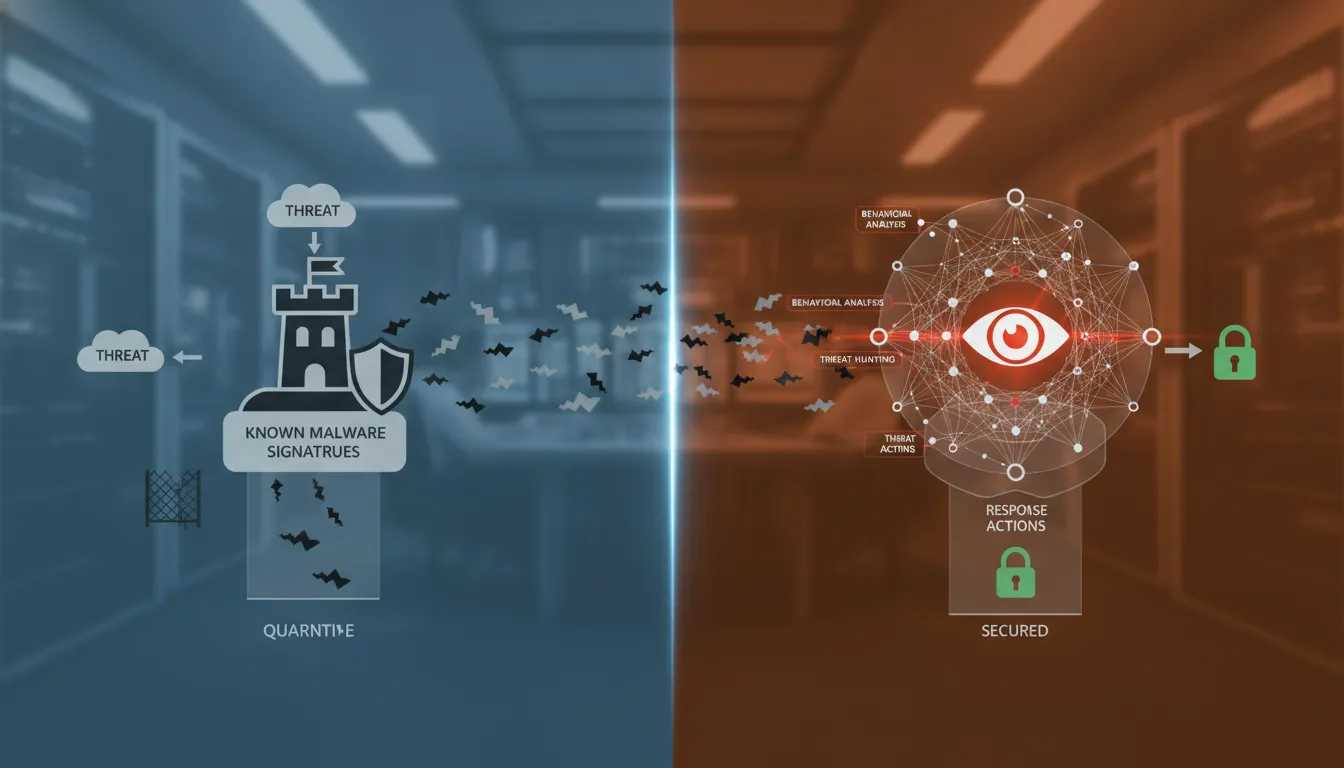
Used together, the controls create a more resilient baseline. Antivirus can stop a known malicious payload before it executes, while EDR can investigate what happened around an alert. Identify suspicious process activity, and help security teams understand whether an attacker attempted to establish persistence or move toward higher-value systems. This layered approach matters because attackers do not always rely on a clearly malicious file. They may abuse legitimate administrative tools or credentials, leaving behavioral signals that static checks alone are unlikely to interpret.
What does a layered endpoint defense look like?
A balanced design assigns each technology a defined role rather than treating them as competing products:
- Antivirus provides baseline prevention. It scans files and applications, blocks known threats, and supplies a foundational control across the endpoint estate.
- EDR provides context and response. It records endpoint events, detects behavioral anomalies, and supports investigation when activity does not match normal operating patterns.
- The SOC or MDR team connects the signals. Analysts can correlate endpoint telemetry with identity, network, and cloud activity, then validate, contain, and prioritize incidents instead of handing every alert to an already-busy internal team.
For mid-market organizations, this division of responsibility is often more practical than pursuing a single tool that claims to cover every scenario. Industry guidance describes antivirus as a first line of defense and EDR as the layer that delivers deeper visibility and enhanced response capabilities. A capable architecture therefore seeks balance between the broad baseline of signature-based prevention and the investigative depth of behavioral detection, rather than choosing one in isolation.
Managed Detection and Response (MDR) extends this model beyond software deployment. By incorporating MDR for advanced threat hunting, an organization gains a dedicated operating function around its EDR data. BCS365's managed MDR service builds on EDR technology with continuous monitoring, human analysis, and guided response, acting as a force multiplier for internal IT and security teams. The result is not simply more alerts, but a clearer path from endpoint signal to defensible action.
Summary: Antivirus supplies essential baseline prevention, while EDR adds behavioral visibility and response. Together, and with MDR oversight, they form a layered defense better suited to the complexity of mid-market environments.
Frequently Asked Questions
What is the difference between EDR and antivirus?
Antivirus primarily identifies known malicious files and signatures, then blocks or contains them. EDR continuously collects endpoint telemetry and analyzes activity for suspicious behavior, giving security teams more context for investigation and response. In practical terms, antivirus focuses on preventing a recognized threat, while EDR helps identify what an attacker is doing across an endpoint.
Do I need EDR if I already have antivirus?
In most environments with meaningful security or compliance requirements, antivirus should be treated as a baseline rather than the complete endpoint strategy. Attackers can use legitimate system tools or previously unseen malware to bypass static file checks. EDR adds behavioral visibility and investigation capability, while antivirus remains a useful first layer.
Is EDR better than traditional antivirus?
EDR is more capable for detecting complex behavior, investigating suspicious activity, and supporting response. It is not a universal replacement for antivirus functions. A mature endpoint program commonly uses both: antivirus for baseline file protection and EDR for deeper monitoring, detection, and response. The right design depends on endpoint coverage, risk tolerance, staffing, and operating model.
How does EDR work compared to antivirus?
Antivirus typically scans files and compares them with known indicators or signatures. EDR records endpoint events such as process activity, connections, and other telemetry, then looks for patterns associated with malicious behavior. That visibility can support threat hunting and help analysts investigate activity that does not involve an obviously malicious file.
Schedule a Security Risk Assessment
Your current endpoint defense may have blind spots that signature-based antivirus alone cannot address. BCS365's Security Risk Assessment evaluates your detection coverage, response readiness, and visibility gaps across your entire environment. Schedule your assessment today and get a clear roadmap for strengthening your endpoint security posture.