
Client demands for independent security reviews are rapidly rising as enterprise vendors face rigorous risk checks. Undergoing an external audit is no longer a luxury for mid-market service providers who handle sensitive customer data. The question is not whether you will need a SOC 2 report, but how quickly you can produce one that passes scrutiny.
SOC 2 compliance is a framework created by the American Institute of Certified Public Accountants (AICPA) that measures how a service organization protects its clients' data. The audit evaluates controls across security, availability, processing integrity, confidentiality, and privacy to produce an official attestation report that enterprise buyers require before signing contracts.
Preparing for this rigorous audit can feel overwhelming for busy internal IT teams who already manage daily infrastructure. Understanding the foundational elements is the first step, and the journey begins with clarifying the SOC 2 compliance requirements so you can map out your pathway to readiness.
Schedule a free security risk assessment today to evaluate your current security posture and identify gaps before your SOC 2 audit begins. Contact our compliance team to get started.
What Is SOC 2 Compliance?
When enterprise clients review your systems, they must know that you keep their data safe. This check is where SOC 2 compliance plays a key role. It is not a legal rule, but most major firms require it before they will sign a contract. Obtaining this report shows that your organization has strong security controls in place to block threats and protect sensitive client data.
At its core, a SOC 2 review is an audit that evaluates how well a service organization manages and secures its data. If you operate in complex fields like Life Sciences or Finance, your clients need this level of trust. Working with a partner to build your SOC 2 audit readiness strategy helps you pass this audit and win larger client deals.
The AICPA Attestation Framework
SOC 2 is not a standard certification. You do not pass or fail it like a school test. Instead, it is an attestation framework developed by the American Institute of CPAs (AICPA). A third-party auditor studies your systems, tests your policies, and writes a detailed report on how well your controls function.
This report focuses on specific rules called the Trust Services Criteria. These criteria are defined by the AICPA with reference to frameworks like the National Institute of Standards and Technology (NIST). The auditor checks your security policies, hardware configurations, and team processes. They then issue an official statement that describes your real security posture to your clients and prospects.
How SOC 2 and ISO 27001 Differ
Many IT directors ask how SOC 2 compares to other compliance standards. ISO 27001 is the most common point of comparison. Both frameworks help you protect sensitive data, but they approach the task differently. ISO 27001 is a global standard that certifies you have a working information security management system (ISMS).
In contrast, SOC 2 is a flexible report that describes the controls you already use. It is widely adopted in the United States, while ISO 27001 is common in global markets. For example, BCS365 holds a current ISO/IEC 27001:2022 certification, which aligns with the core requirements of SOC 2. This shared alignment makes it much easier to build and prove your controls when you begin your audit journey.
SOC 2 compliance is a key business asset that builds deep trust with enterprise clients.
What Are the Five Trust Services Criteria?
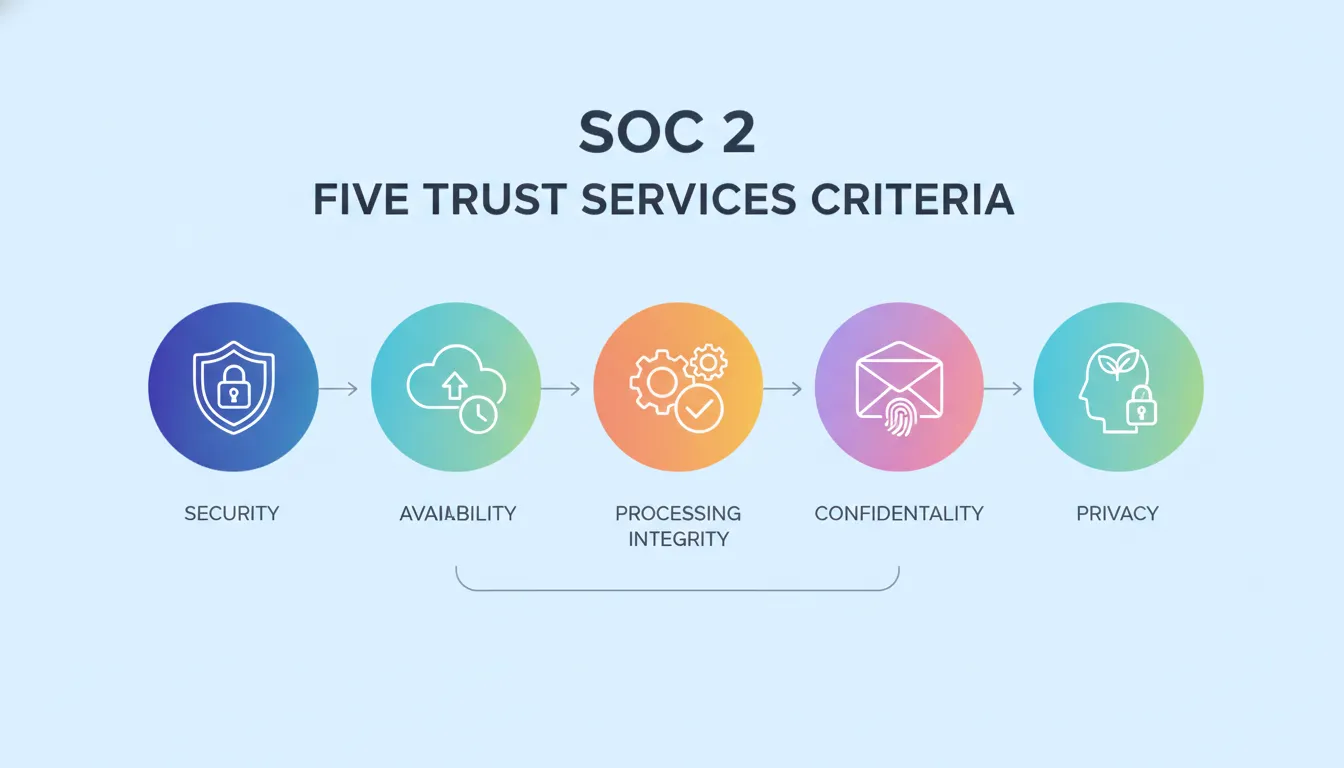
Summary: The five Trust Services Criteria (TSC) are Security, Availability, Processing Integrity, Confidentiality, and Privacy. Security is the mandatory criteria required in every audit. The other four are optional based on your business model and the data you handle.
When preparing for a SOC 2 audit readiness assessment, you must decide which criteria to include in your scope. The AICPA developed these categories to help service organizations evaluate and report on their data control systems. Under the AICPA framework, outlined by the National Institute of Standards and Technology, these criteria form the bedrock of your information security policies.
- Security (Common Criteria): Protects systems against unauthorized access, data theft, and system damage. This is the only mandatory category in every SOC 2 audit. Key controls include firewalls, multi-factor authentication, and intrusion detection systems.
- Availability: Ensures systems, products, or services remain operational as contractually agreed. Vital for SaaS providers and data centers. Key controls include performance monitoring, disaster recovery plans, and redundant infrastructure.
- Processing Integrity: Verifies that systems process data accurately, in a timely manner, and without authorization errors. Critical for fintech providers and transaction processors. Key controls include data validation, error tracking, and transaction monitoring.
- Confidentiality: Applies to data you agree to restrict to specific individuals. Covers intellectual property, business plans, and financial documents. Key controls include encryption, strict access privileges, and secure data disposal methods.
- Privacy: Addresses how you collect, use, retain, disclose, and delete personally identifiable information (PII). Highly relevant for healthcare, biotech, and retail organizations. Key controls include consent management, privacy disclosures, and retention policy enforcement.
Partner with an experienced managed IT provider to scope your Trust Services Criteria correctly and avoid costly rework.
SOC 2 Type 1 vs. Type 2: What IT Directors Need to Know
Summary: A SOC 2 Type 1 report verifies that your security controls are designed appropriately at a single point in time. A Type 2 report proves that those same controls operate effectively over a testing period of six to twelve months. Enterprise buyers require Type 2 reports for vendor approval.
When you begin your path toward SOC 2 compliance, you must choose between a Type 1 and a Type 2 audit. Both reports evaluate your data controls, but they serve different business objectives. Understanding how they differ is essential for planning your budget and meeting customer demands.
Point-in-Time Design vs. Operational Proof
A Type 1 audit is analogous to a photograph of your security posture. The auditor verifies that your described controls exist and are designed to meet the Trust Services Criteria on a specific date. This report is faster to obtain and costs less, making it a practical first step for organizations new to compliance.
A Type 2 audit is a full video of your operations. The auditor evaluates how well your controls function over an extended period, typically six to twelve months. This review tests whether your team follows documented policies consistently, not just on the day of the audit.
Why Enterprise Prospects Require Type 2 Reports
Most large business clients do not accept a Type 1 report for long-term vendor assessments. They require proof that you protect their data day in and day out. Enterprise buyers prefer to leverage SOC 2 reports for vendor assessment only when those reports are Type 2, as they demonstrate sustained operational security.
A Type 2 report also carries more weight with financial and security auditors. While a SOC 1 report addresses internal controls for financial reporting, a SOC 2 report focuses on security and privacy (AICPA). A Type 2 report demonstrates that your systems can withstand threats over time, which builds lasting trust with clients.
| Feature | SOC 2 Type 1 | SOC 2 Type 2 |
|---|---|---|
| Audit Window | Single point in time (one day) | Six to twelve months |
| What It Tests | Design of security controls | Design and operational effectiveness of controls |
| Time to Complete | A few weeks | Six to twelve months of data collection |
| Enterprise Value | Low (often used as a starting step) | High (required by most major buyers) |
Building Type 2 Evidence with Managed IT and MDR
Passing a Type 2 audit requires continuous evidence collection. Manual checks cannot gather months of security logs at the fidelity auditors demand. To build a strong audit trail, you need 24/7 network monitoring and active threat tracking.
Using Managed Detection and Response (MDR) helps you collect this evidence automatically. An MDR system maintains constant vigilance over your endpoints and networks. It logs every security event and blocks threats in real time. This continuous monitoring provides your auditor with the long-term operational proof they need to sign off on your Type 2 report.
If you need help establishing these security capabilities, explore specialized cybersecurity services. An expert team can configure your logging infrastructure and monitor your environment so you remain audit-ready at all times.
How to Build Your SOC 2 Compliance Roadmap
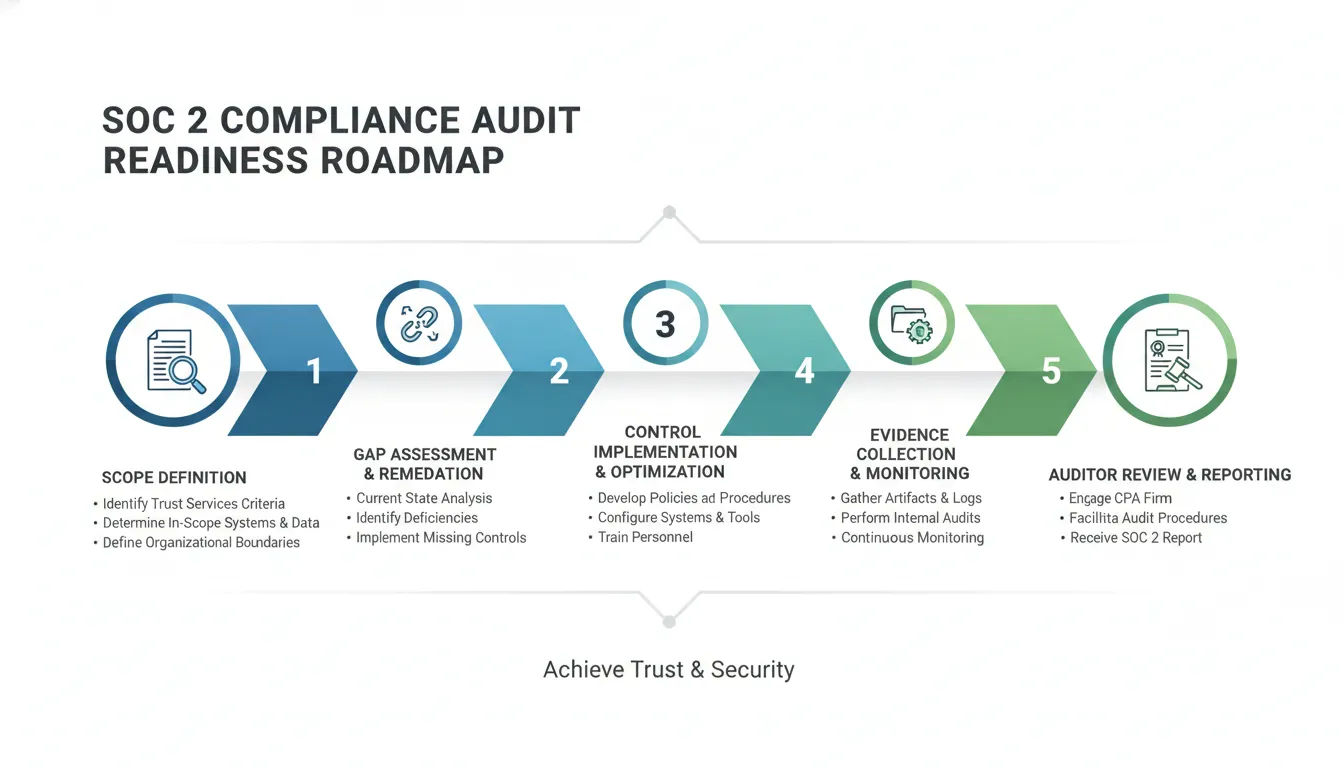
Summary: Building a SOC 2 compliance roadmap involves five phases: define scope, run a gap assessment, implement controls, collect evidence, and engage the auditor. Mid-market teams can accelerate this process by leveraging managed IT support with 24/7 monitoring and ISO 27001 alignment.
Preparing for a SOC 2 audit requires a structured plan. Mid-market companies must build a framework that satisfies the AICPA Trust Services Criteria. By following a methodical approach, your team can avoid common pitfalls and complete the audit efficiently. A well-designed roadmap also helps you maintain your security posture over the long term.
- Define Your Scope: Select which of the five Trust Services Criteria apply to your systems. Security is the only mandatory category. You may also need to demonstrate Availability, Processing Integrity, Confidentiality, or Privacy based on your business model. Identifying the right boundaries prevents your team from spending time on systems that do not handle sensitive client data.
- Run a Gap Assessment: Compare your current security posture against the chosen AICPA criteria. This analysis reveals where your controls fall short. It helps identify weaknesses in your network architecture, security policies, and access logs before an auditor reviews them. Use this stage to plan remediation and estimate the effort needed to reach SOC 2 audit readiness.
- Implement Controls: Deploy the necessary safeguards once you know your gaps. This phase includes writing security policies, configuring access controls, hardening systems, and establishing monitoring procedures. To accelerate this work, engage managed IT services. A skilled partner can configure firewalls, manage patch cycles, and secure cloud infrastructure to meet compliance requirements.
- Collect Evidence and Monitor: Passing a SOC 2 audit requires proof that your controls work. The AICPA requires service providers to demonstrate sustained security over time. A reliable approach is to use managed compliance services. With 24/7/365 monitoring, you can log every relevant event and collect the system data your auditor will request.
- Engage the Auditor: Hire an independent CPA firm to perform the audit. The auditor reviews your policies, inspects system configurations, and tests your controls. If you have maintained detailed logs of your network activity, this stage proceeds quickly. Once the review is complete, the auditor issues your official SOC 2 report.
How Managed IT Support Helps Your Team
Building a roadmap independently can strain your internal staff. Managed IT providers act as a force multiplier, taking the operational burden off your team. Providers like BCS365 are ISO/IEC 27001:2022 certified, which gives you a head start toward compliance. This certification means their operational practices already satisfy many of the controls your auditor will test.
Continuous oversight is also critical for the evidence collection phase. BCS365 provides 24/7/365 monitoring to help detect and remediate issues quickly. With this round-the-clock visibility, your team can maintain secure systems and collect audit evidence automatically.
Schedule a consultation with our compliance team to map your audit roadmap and close your control gaps before the formal assessment begins. Book your discovery session today.
Why Managed IT Support Accelerates SOC 2 Audit Readiness
Summary: Managed IT support accelerates SOC 2 audit readiness by providing pre-built compliant workflows. Automated evidence logging, and 24/7 threat detection that satisfies auditor requirements without burdening internal teams.
Preparing for a SOC 2 audit can consume months of internal effort. Your team must design, implement, and document hundreds of security controls. A mature managed IT support partner acts as a force multiplier by providing pre-built systems that already meet strict audit standards. Since BCS365 maintains ISO/IEC 27001:2022 certification, our operational workflows align naturally with the security controls required for SOC 2 compliance.
Pre-Built Controls and Continuous Evidence Logging
Auditors do not merely check whether a security control exists. They require historical evidence that the control has functioned effectively over an extended period. Setting up logging systems and maintaining these records can overwhelm internal IT teams. Strategic managed IT services simplify this process by running continuous logging across your infrastructure. These systems automatically record configuration changes, patch updates, and user access events. When audit time arrives, you can download ready-to-submit evidence packages directly from the management console, eliminating hundreds of hours of manual log searching.
Automated continuous logging ensures that auditors receive organized, ready-to-submit evidence packages without manual data gathering.
Active Cyber Threat Defense via MDR
To pass a SOC 2 audit under the Security trust criterion, your organization must demonstrate that it can detect and respond to live cyber threats. The National Institute of Standards and Technology (NIST) frameworks emphasize continuous monitoring as a core defense requirement. Most internal IT teams lack the budget and personnel to operate a 24/7 Security Operations Center (SOC). By leveraging Managed Detection and Response (MDR), you gain access to a fully staffed, around-the-clock security team. We monitor your endpoints, network, and cloud workloads continuously, providing the real-time threat response that auditors expect to see in your compliance reports.
Managed Detection and Response (MDR) satisfies SOC 2 threat detection requirements through professional 24/7/365 security monitoring.
Compliance Expertise for Complex Sectors
SOC 2 audits vary significantly by industry and business model. Life sciences and finance firms must align their security controls with sector-specific regulations alongside their SOC 2 audit readiness roadmap. An experienced IT partner brings deep compliance expertise to your strategic planning phase. We help design a security architecture that satisfies multiple frameworks simultaneously, eliminating duplicate work. This structured approach enables mid-market organizations to build mature security programs that protect their data and satisfy enterprise clients without adding operational friction.
Sector-specific compliance expertise helps organizations design unified security architectures that satisfy multiple regulatory frameworks simultaneously.
How Long Does SOC 2 Compliance Take?
Summary: Most organizations complete their first SOC 2 audit in six to twelve months from start to finish. Organizations with mature security programs and established controls can complete the process significantly faster.
The timeline for completing a SOC 2 audit depends on your starting point and organizational complexity. For most mid-market businesses, the first audit cycle takes six to twelve months from scoping to report issuance. If you already operate a mature security program with documented controls, this timeframe can be compressed considerably.
You can explore different compliance pathways through managed compliance services. This support helps you plan each phase and avoid common scheduling delays.
Key Factors That Affect Your Audit Timeline
Several variables influence your SOC 2 audit schedule. The size of your infrastructure and the number of employees directly determine the audit scope. The number of Trust Services Criteria you include also affects the timeline. Adding optional criteria such as Privacy or Availability means more controls to document and test.
Your existing security maturity is the single largest factor. Organizations that already track system events and maintain documented policies will spend less time in the preparation phase. Organizations that need to build these systems from scratch should budget additional time.
How Continuous Monitoring Speeds Up the Process
Building your security controls is one task. Proving they work over months of operation is a separate, more time-intensive challenge. Continuous monitoring platforms operated by managed IT providers automatically collect and retain the evidence your auditor needs. With automated logging in place, your team does not need to reconstruct six months of event history manually. This capability can reduce your overall audit preparation timeline by several months.
Who Needs SOC 2 Compliance?
Summary: Any service organization that handles customer data and operates in a regulated or enterprise-facing industry should pursue SOC 2 compliance. Software companies, managed service providers, professional services firms, and B2B vendors are the most common candidates.
SOC 2 compliance is most relevant for organizations that store, process, or transmit customer data as part of their service delivery. If your clients are enterprise organizations with formal vendor risk management programs, SOC 2 is effectively mandatory for contract approval.
Software as a Service and Cloud Providers
SaaS companies are the most common SOC 2 audit candidates. Enterprise buyers routinely require SOC 2 reports before approving cloud software subscriptions. The audit framework maps directly to the security, availability, and confidentiality concerns that arise when customer data resides on third-party infrastructure.
Managed Tech and Professional Services
Managed service providers (MSPs) and professional services firms that access client networks or handle sensitive data benefit directly from SOC 2 compliance. The audit provides independent verification that your internal controls meet industry standards, which strengthens client trust and differentiates your firm in competitive procurement processes.
Mid-Market B2B Vendors and Procurement
Mid-market organizations that supply products or services to larger enterprises increasingly face SOC 2 requirements in their procurement contracts. Achieving compliance positions your firm as a lower-risk vendor, which can accelerate deal cycles and reduce the volume of individual security questionnaires you must complete for each prospect.
Frequently Asked Questions
Is SOC 2 compliance a legal requirement?
SOC 2 compliance is not a legal or regulatory mandate. It is a voluntary framework developed by the AICPA. However, most enterprise organizations and regulated industries require SOC 2 reports as a precondition for vendor contracts. Many contracts include SOC 2 language in their security addendums, making it a de facto business requirement even though no statute compels it.
What is the difference between a SOC 1 and a SOC 2 report?
SOC 1 reports focus on internal controls over financial reporting (ICFR). They are relevant for organizations whose services affect their clients' financial statements. SOC 2 reports focus on security, availability, processing integrity, confidentiality, and privacy controls. For most technology and service organizations, a SOC 2 report is the appropriate framework for demonstrating security posture to enterprise clients.
What is the difference between SOC 2 Type 1 and Type 2?
A Type 1 report evaluates whether your controls are designed appropriately at a single point in time. A Type 2 report evaluates whether those controls operate effectively over a period of six to twelve months. Enterprise buyers typically require Type 2 reports because they provide evidence of sustained operational effectiveness rather than a one-time snapshot.
What are the five Trust Services Criteria?
The five Trust Services Criteria are Security, Availability, Processing Integrity, Confidentiality, and Privacy. Security is the mandatory common criteria required in every SOC 2 audit. The remaining four are optional and selected based on your business model and the type of data you handle. Most organizations include Security plus one or two additional criteria that align with their service commitments.
How much does a SOC 2 compliance audit cost?
SOC 2 audit costs vary based on organizational size, scope of criteria, and auditor selection. For mid-market organizations, a Type 2 audit typically ranges from $30,000 to $100,000 for the formal assessment. Preparation costs, including control implementation, tooling, and personnel time, can add significantly more. Engaging a managed IT provider with pre-built compliance infrastructure can reduce both audit preparation time and total cost of compliance.
Ready to Start Your SOC 2 Compliance Journey?
Achieving SOC 2 compliance requires deliberate planning, disciplined execution, and sustained operational rigor. The framework demands that your controls are not only designed correctly but also proven effective over time. For mid-market IT teams already managing daily operations, building this capability from scratch can divert focus from strategic initiatives.
BCS365 helps organizations like yours navigate the full SOC 2 compliance lifecycle. From gap analysis and control implementation through evidence collection and auditor engagement, our team provides the infrastructure and expertise you need to achieve and maintain audit readiness.
Schedule a free security risk assessment today to evaluate your current posture and build your compliance roadmap. Contact our team to get started.