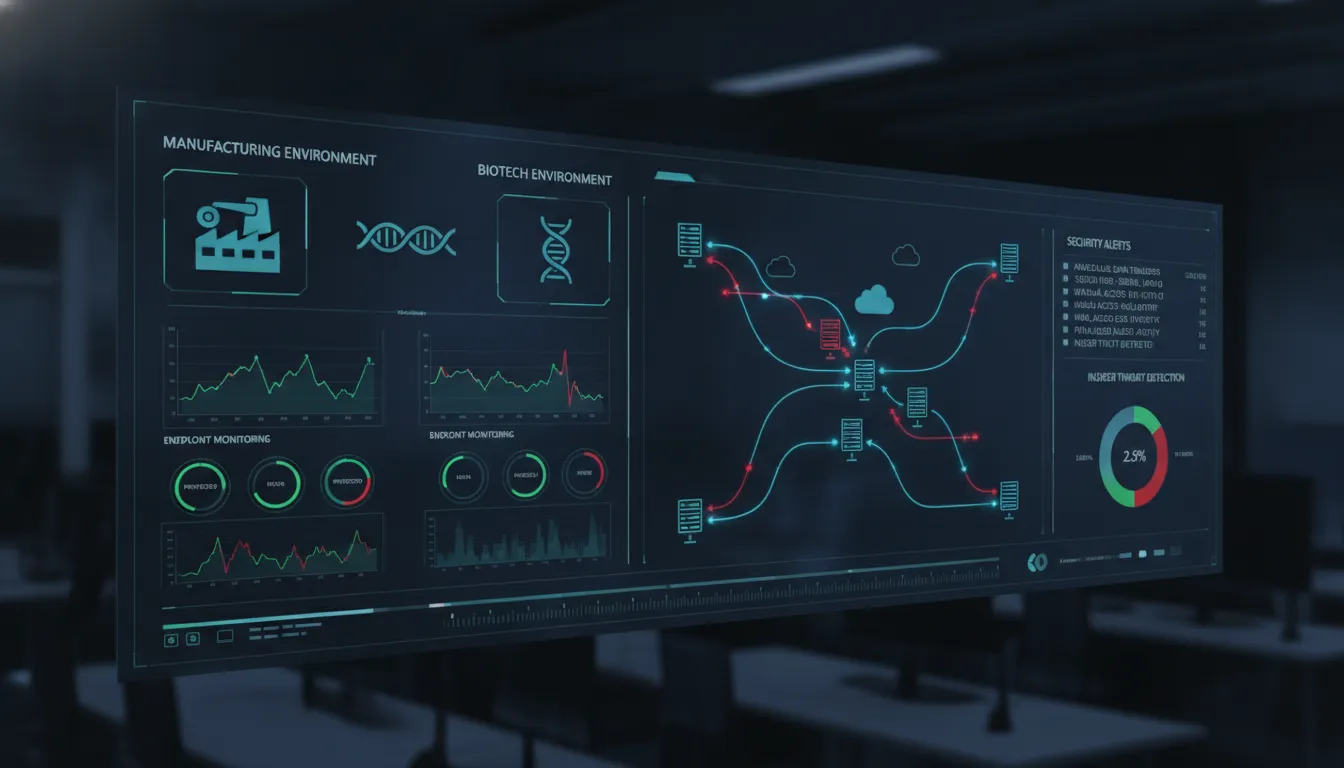
OT Security Manufacturing: ICS Protection for Manufacturers

Manufacturing systems cannot be secured like ordinary office endpoints. A brief interruption to a programmable logic controller, SCADA environment, or other industrial control system can affect safety, throughput, quality, and customer commitments, while many of these systems still depend on legacy technology built decades ago. Connectivity and Industry 4.0 initiatives increase visibility and efficiency, but they also expand the paths an attacker may use.
OT security manufacturing programs protect the integrity, safety, and availability of industrial control systems and the operational processes they run. Effective protection combines accurate asset visibility, disciplined separation between IT and OT, tightly governed remote access, and monitoring designed around production realities.
The objective is not to impose controls that disrupt the plant. It is to establish risk-based safeguards that preserve reliable operations while reducing opportunities for unauthorized access and lateral movement. That starts with defining what OT security covers, why its priorities differ from traditional IT, and how those differences shape a practical program.
Ready to assess your industrial control system security posture? Schedule a Security Risk Assessment to identify vulnerabilities across your OT environment without disrupting production.
What Is OT Security in Manufacturing and Why Does It Matter?
OT security protects the systems that sense, control, and automate physical manufacturing processes. Unlike business applications, these environments directly influence equipment behavior, production quality, worker safety, and facility operations. A sound program therefore protects the integrity, safety, and availability of industrial control systems, not only the confidentiality of information. OT security research describes this discipline as the protection of industrial operations and critical infrastructure.
Operational Technology commonly includes programmable logic controllers (PLCs), supervisory control and data acquisition (SCADA) platforms, distributed control systems (DCS), human-machine interfaces (HMIs), industrial sensors, robotic systems, and the networks connecting them. These components may run continuously, support tightly controlled processes, and require specialized protocols and maintenance windows. Many manufacturing environments still depend on PLC or SCADA deployments that originated in the 1980s or 1990s, which can make patching, authentication, and modernization difficult. Research on legacy OT systems documents the persistence of these older architectures.
Why OT security has a different operational mandate
General IT cybersecurity often centers on protecting data and services through confidentiality, integrity, and availability controls. OT security must apply those principles without creating an unsafe state or interrupting a process that cannot be stopped casually. A security control that is routine in IT, such as an aggressive scan, reboot, or untested patch, can affect equipment performance or production continuity in OT. Risk decisions must account for engineering constraints, safety requirements, asset dependencies, and the consequences of downtime.
How Industry 4.0 expands the attack surface
Industry 4.0 connects plant-floor systems to analytics, enterprise platforms, cloud services, remote support tools, and Industrial Internet of Things (IIoT) devices. That connectivity can improve visibility, automation, and production efficiency, but it also creates more paths between previously separated environments. IIoT machine-to-machine communication introduces interoperability and data-security challenges, while IT and OT convergence can expose control systems to vulnerabilities originating in business networks. Manufacturers evaluating IT and OT convergence security should map these dependencies before adding access or connectivity.
In summary: OT security safeguards the industrial systems behind safe, reliable production. It must account for legacy control technology while managing the expanded attack surface created by Industry 4.0, IIoT, and IT/OT connectivity. An asset inventory and dependency map are the foundation for any industrial security program.
How OT Security Differs from Traditional IT Security
Manufacturing security teams cannot apply an IT security playbook to operational technology without adapting it to production realities. In IT, confidentiality and rapid remediation often lead the decision process. In OT, availability, process integrity, and safety usually take precedence because an interruption can affect equipment, output, and people. The distinction is central to effective OT security manufacturing programs, particularly where business networks and industrial control systems now exchange data at scale.
| Dimension | IT Security | OT Security (Manufacturing) |
|---|---|---|
| Primary priority | Confidentiality and data integrity | Availability, safety, and process integrity |
| Patch cycle | Weekly or monthly updates | Maintenance windows scheduled months in advance, if at all |
| System lifespan | 3-5 years | 10-20+ years, often with unsupported operating systems |
| Risk tolerance | Data breach is the main concern | Unplanned downtime and safety incidents are the main concerns |
| Protocol environment | HTTP, HTTPS, SQL, TCP/IP stacks | Proprietary ICS protocols (Modbus, Profinet, EtherNet/IP, OPC, DNP3) |
| Testing window | Staging or CI/CD, rollback is straightforward | Full production replica rare; rollback can require equipment recertification |
These differences mean that OT security requires controls designed for industrial constraints. Antivirus scanning that consumes CPU cycles or automated patch reboots that occur during a production run can create more risk than they prevent. NIST SP 800-82 Rev. 3 provides detailed guidance on adapting IT security controls for industrial environments.
Summary: OT security inverts the IT priority model, placing availability and safety above confidentiality. Patching, testing, and monitoring must all operate within production constraints that do not exist in business IT environments. A comparison table of IT versus OT security priorities helps plant teams communicate these differences to enterprise security leadership.
The Real Threat Landscape for Industrial Control Systems
Industrial control environments face threats from ransomware operators, nation-state actors, insider threats, and supply-chain compromises. Several well-documented incidents illustrate how widely the vectors vary.
In 2023, the Clop ransomware group exploited a zero-day in the MOVEit managed-file-transfer platform to breach hundreds of organizations, including multiple manufacturing firms whose OT data was exfiltrated before detection. According to the Dragos 2023 ICS Year in Review, ransomware continued to be the leading threat to industrial organizations, accounting for over 60 percent of all ICS-related incidents.
The Cybersecurity and Infrastructure Security Agency (CISA) has documented multiple instances where state-aligned threat actors gained persistent access to OT environments through IT/OT convergence paths. In one advisory, CISA reported that threat actors maintained access to an industrial control network for over six months by compromising IT domain controllers and then establishing jump hosts into the ICS environment. Manufacturing accounted for over 30 percent of all reported ICS incidents tracked by industrial cybersecurity firm Dragos in 2023.
The air gap that once isolated industrial systems is largely a myth. A 2022 SANS survey found that over 70 percent of industrial organizations have OT assets with direct or indirect internet connectivity, and fewer than 40 percent maintain a complete asset inventory. Attackers routinely exploit these visibility gaps to move laterally from IT into OT environments without triggering conventional detection tools.
Summary: The OT threat landscape includes ransomware, nation-state intrusions, and supply-chain attacks, with manufacturing as the most-targeted industrial sector. Network visibility gaps and persistent IT/OT convergence paths create exploitation opportunities that conventional IT monitoring alone cannot detect.
Is your manufacturing environment exposed? Explore BCS365 manufacturing cybersecurity solutions to identify and close visibility gaps between your IT and OT networks.
Building an OT Security Program: CISA Best Practices and Beyond
CISA has published several guidance documents that provide a practical starting point for OT security programs. The CISA CPG (Cross-Sector Cybersecurity Performance Goals) for Industrial Control Systems outline 23 prioritized actions that apply across manufacturing verticals, organized by implementation difficulty.
Inventory every OT asset and maintain network visibility
You cannot protect what you cannot see. Deploy passive or low-impact active scanning tools that can discover PLCs, RTUs, HMIs, and other OT assets without disrupting production. Maintain a hardware and software inventory that includes firmware versions, patch status, and network connectivity. Update this inventory on a recurring schedule tied to plant maintenance cycles.
Segment IT and OT networks with a DMZ architecture
Use one or more industrial DMZs to control traffic between business networks and control system networks. Allow only the specific protocols and ports that documented operational use cases require. Block all other traffic, including general internet access, email, and file-sharing protocols, from the OT environment. The NIST SP 800-82 reference architecture provides segment design patterns for different Purdue model levels.
Remove OT connections to the public internet
Audit every OT asset for direct or indirect internet access. Eliminate direct remote-desktop, VPN-less, and cloud-managed connections to control-system endpoints. Where remote access is genuinely required, place jump hosts in the DMZ with session recording, multi-factor authentication, and time-bound approval workflows.
Replace default passwords and enforce strong authentication
Many OT devices ship with default credentials that are shared across entire product lines and documented in public manuals. Audit all control-system devices, change default passwords, and implement role-based access controls. Where device-level authentication is limited, compensate with network-level controls at the switch or firewall boundary.
Apply least privilege to remote access
Every remote session into an OT environment should have a defined business justification, an expiration time, and recorded activity logs. Grant the minimum privileges needed for the task, disable accounts after their session window closes, and review vendor access at least quarterly. Treat remote OT access as a high-risk exception that requires separate approval.
Implement continuous monitoring and risk management
Deploy monitoring tools that understand industrial protocols and can detect anomalous behavior without requiring software agents on legacy controllers. Establish a risk register that tracks unpatched vulnerabilities, segmentation gaps, and internet-exposed devices. Review the register monthly with both IT security and plant engineering stakeholders.
Summary: A resilient OT security program combines asset visibility, IT/OT segmentation, removal of unnecessary internet connectivity, replacement of default credentials, least-privilege remote access, and continuous monitoring aligned to industrial protocols. These six actions form the practical foundation that CISA guidance emphasizes across manufacturing verticals.
How Managed Detection and Response Strengthens OT Environments
MDR services designed for industrial environments can help mid-market manufacturers maintain visibility into OT threats without building a 24/7 security operations center. BCS365 delivers Managed Detection and Response (MDR) that accounts for industrial protocols, legacy system constraints, and the operational rigors of manufacturing environments.
Visibility across the industrial network
MDR for OT deploys passive network monitoring, log collection from ICS-specific sources, and integration with existing security tools. Analysts correlate signals across IT and OT environments to identify reconnaissance, lateral movement, and anomalous process behavior that point to an active threat. The top MDR solutions for mid-market enterprises provide capabilities that extend from corporate networks into control-system environments.
From alert triage to coordinated response
When an MDR analyst identifies suspicious activity in an OT environment, the response process must respect production constraints. Analysts assess whether the behavior represents an actual threat, a configuration change, or normal process variation. If escalation is warranted, the response plan includes plant engineering stakeholders who can advise on safe containment actions. This coordination between security operations and production teams is essential for maintaining safety while addressing real threats.
Summary: MDR extends security monitoring into OT environments by deploying passive ICS-aware detection, correlating IT and OT signals, and coordinating response actions with plant engineering teams to avoid production disruption. Mid-market manufacturers can achieve 24/7 threat coverage without a dedicated in-house SOC.
Need a security partner that understands both IT and OT environments? Contact BCS365 to discuss how our MDR service extends protection to your industrial control systems while respecting production requirements.
Frequently Asked Questions
What should a manufacturing company secure first in its OT environment?
Start with an accurate inventory of industrial control assets, network connections, remote-access paths, and business dependencies. Prioritize systems whose compromise could affect worker safety, production availability, product quality, or environmental controls. This baseline helps the security team identify exposed assets and sequence improvements without applying disruptive controls blindly.
How can manufacturers separate IT and OT networks without disrupting production?
Use a risk-led architecture that separates enterprise and industrial networks, typically with controlled conduits and an industrial DMZ between them. Document the traffic each process requires, remove unnecessary connections, and test rule changes during approved maintenance windows. Segmentation should reduce lateral movement while preserving the predictable communications that controllers and supervisory systems need.
What remote-access controls are essential for industrial control systems?
Permit remote access only when there is a defined operational need. Place it behind a controlled access path with least-privilege permissions, strong authentication, session logging, and time limits. Disable dormant accounts and review vendor access regularly. Remote connectivity should be treated as a high-risk exception, not a permanent convenience for administrators or equipment providers.
Can Managed Detection and Response (MDR) monitor OT environments?
Yes, when the service is designed to account for industrial protocols, safety requirements, legacy systems, and strict uptime expectations. MDR can correlate signals across IT and OT, maintain visibility into industrial assets, and support investigation and response without treating every unusual process event as a conventional endpoint alert. The operating model should define escalation paths that include plant engineering stakeholders before any containment action.
Ready to strengthen your OT security program? Schedule a Security Risk Assessment to identify exposure across industrial control systems and prioritize practical safeguards without losing sight of operational requirements.