

What are managed IT services? For a CIO, they are an accountable operating model that transfers defined technology responsibilities to a specialist partner under measurable service levels. The model combines continuous operations, cybersecurity, cloud and infrastructure management, and strategic guidance so internal teams can focus on transformation rather than recurring operational demands.
Schedule a discovery session to assess where a managed or co-managed operating model could reduce risk and expand your team's capacity.
The strategic question is not simply which activities can be outsourced. It is which capabilities, controls, and outcomes should have clear external accountability. This guide explains the scope, governance, expected outcomes, commercial structure, and evaluation criteria that help technology leaders make that decision.
What are managed IT services?
Managed IT services are ongoing technology operations delivered by an external provider under a defined agreement. They typically combine monitoring, support, infrastructure management, cybersecurity, cloud operations, and advisory services. The provider assumes accountability for agreed outcomes, while the client retains governance, business priorities, and final decision authority.
Unlike project consulting, managed services are designed for continuous delivery. The provider integrates people, processes, tooling, and reporting into an operating system for technology. This creates a repeatable way to manage risk, capacity, and performance across an increasingly complex environment.
An accountable operating model
A mature engagement begins with a service boundary. The agreement identifies which systems are in scope, who owns each decision, how incidents are escalated, and which metrics define acceptable performance. This is materially different from purchasing blocks of support hours. The emphasis is on outcomes and accountability, not activity volume.
The provider may own day-to-day execution while the CIO retains strategic control. That division allows an internal team to direct architecture, data, applications, and transformation priorities without carrying every operational specialty in-house. BCS365 describes this approach as a force multiplier, especially when a mature internal team needs deeper expertise or continuous coverage.
Proactive operations rather than reactive support
Traditional break-fix support responds after disruption occurs. A managed model uses telemetry, maintenance disciplines, documented standards, and trend analysis to identify conditions before they become incidents. Its value comes from preventing avoidable failure, reducing exposure, and creating a controlled response when disruption does occur.
This proactive posture should extend beyond uptime. It includes configuration management, vulnerability remediation, identity controls, backup assurance, capacity planning, and lifecycle governance. The result is an operating environment that can support growth without accumulating unmanaged risk.
What does a managed IT services agreement cover?
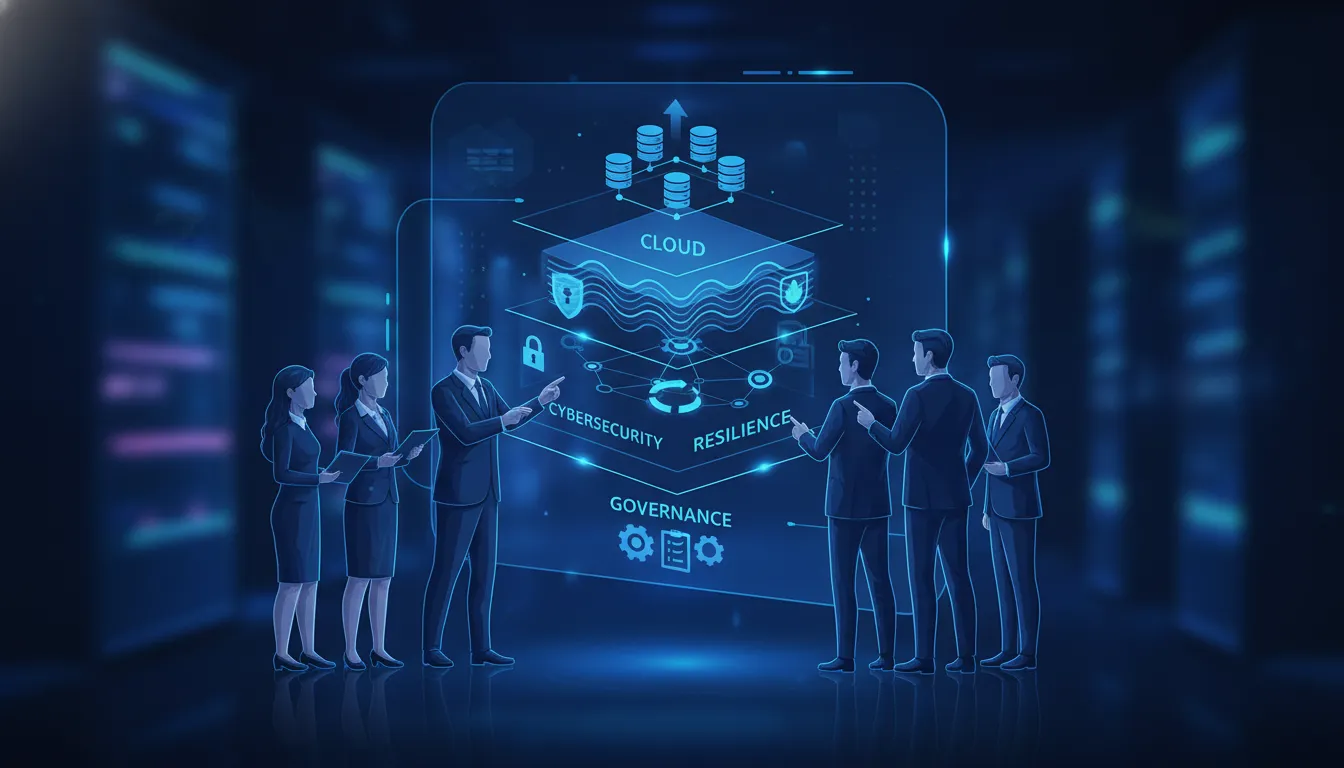
A managed IT services agreement defines service scope, ownership, response expectations, security requirements, governance routines, reporting, exclusions, and commercial terms. It should make accountability unambiguous. A CIO should be able to see which outcomes the provider owns, how performance is measured, and how exceptions or material risks are escalated.
Scope varies by organization, but a comprehensive agreement often covers the following capability domains:
- Service operations: service desk, incident management, problem management, request fulfillment, and escalation.
- Infrastructure and cloud: endpoint, network, server, platform, backup, and cloud resource administration.
- Cybersecurity: security monitoring, vulnerability management, Managed Detection and Response (MDR), identity controls, and incident coordination.
- Governance: service reviews, risk registers, roadmaps, architecture standards, and compliance evidence.
- Lifecycle management: asset visibility, warranty and license oversight, patching, and technology refresh planning.
Service levels and operating metrics
Service-level agreements should measure more than response time. Useful indicators include resolution performance, recurring incident reduction, patch compliance, backup recovery assurance, change success, security remediation aging, and service availability. The metric set should connect operational execution to business risk and resilience.
Executives should also distinguish a contractual service level from an operational target. A contractual threshold establishes the minimum commitment. An operational target should drive continuous improvement. Quarterly service reviews can then identify trend lines, root causes, and investment priorities instead of merely reporting ticket counts.
Governance, controls, and evidence
Regulated organizations need evidence that services are delivered through controlled, repeatable processes. The agreement should address data handling, access governance, subcontractors, incident notification, business continuity, audit support, and control ownership. Certifications such as ISO/IEC 27001:2022 can support due diligence, but they should complement direct validation of the provider's operating practices.
A provider should also explain how its controls align with your obligations. In life sciences, finance, insurance, manufacturing, and critical infrastructure, generic assurances are insufficient. The operating model must produce usable evidence for audits, risk committees, and executive reporting.
Which outcomes should CIOs expect?
CIOs should expect measurable improvements in resilience, security posture, operating consistency, cost predictability, and access to specialized expertise. The strongest managed IT relationships also increase the internal team's strategic capacity. Outcomes should be defined as business-relevant trends, supported by operational metrics and reviewed through a formal governance cadence.
Managed services do not create value simply by moving work outside the organization. Value appears when the new model improves control, reduces risk, and accelerates priorities that previously competed with operational demands.
Greater resilience and lower operational risk
Continuous monitoring and disciplined maintenance can reduce the frequency and impact of avoidable incidents. Effective providers also improve recovery readiness through tested backups, documented dependencies, escalation paths, and response procedures. The goal is not a claim that disruption will never happen. It is a defensible ability to prevent, contain, and recover.
Stronger security and compliance execution
Security programs often struggle because critical work spans infrastructure, identity, endpoints, cloud platforms, and governance. A managed partner can coordinate those disciplines and provide specialist capacity around the clock. Capabilities such as a Security Risk Assessment help validate whether controls perform as intended, rather than relying only on configuration reviews.
More strategic capacity for internal IT
A well-designed model removes recurring operational burden without displacing internal leadership. Internal teams can focus on architecture, data, automation, application strategy, and business alignment. This is why co-managed IT services can be effective for organizations that already have capable teams but need broader coverage or specialist depth.
Talk with BCS365 about your operating model if operational risk is limiting transformation capacity or specialist coverage.
Managed vs. co-managed vs. break-fix IT
The right model depends on internal maturity, risk tolerance, service coverage, and the capabilities the organization wants to retain. The comparison below frames the decision for mid-market technology leaders.
| Model | Primary ownership | Best fit | Key consideration |
|---|---|---|---|
| Fully managed IT | Provider owns most agreed operations | Organizations seeking comprehensive operational accountability | Requires precise scope, governance, and transition planning |
| Co-managed IT | Internal and provider teams divide responsibilities | Mature teams needing specialist depth, scale, or 24/7 coverage | Requires clear interfaces and shared operating standards |
| Break-fix support | Client retains ownership; vendor responds on demand | Limited, noncritical environments with low complexity | Reactive incentives and limited prevention or governance |
When fully managed IT is appropriate
A fully managed model can provide a single point of accountability across service operations, infrastructure, cloud, and security. It is most effective when the provider has the technical depth and governance maturity to manage complex environments. The client still needs an executive owner who connects technology performance with business strategy.
When co-managed IT creates more value
Co-managed IT is often the stronger choice when internal teams understand the business and own strategic platforms but cannot efficiently maintain every specialty. The partner can assume defined domains, such as 24/7 operations, security monitoring, cloud engineering, or service desk coverage. For a deeper comparison, review BCS365's guide to managed, in-house, and hybrid IT models.
The limits of break-fix support
Break-fix support can appear economical because spending occurs only when help is requested. However, the model does not inherently reward prevention, standardization, or long-term risk reduction. For environments where downtime, cyber risk, or compliance failures have material consequences, a reactive model often creates unacceptable uncertainty. See the detailed comparison of break-fix and managed services.
How should you evaluate a managed IT services provider?
Evaluate a managed IT services provider across technical depth, security rigor, governance maturity, service transparency, transition capability, and cultural fit. Require evidence, not assurances. The provider should demonstrate how it operates, how it measures outcomes, how it handles incidents, and how it will collaborate with internal stakeholders throughout the relationship.
A procurement checklist is necessary, but it is not sufficient. Technology leaders should test whether the provider can understand business context, make sound architectural decisions, and communicate risk clearly to both technical and executive audiences.
Verify technical and security rigor
Ask who will deliver the service, where expertise resides, and how escalations reach senior engineers. Review the provider's capabilities across cloud, network, endpoint, identity, cybersecurity, and compliance. BCS365 combines U.S.-based in-house delivery with offensive security expertise and industry-specific compliance knowledge, allowing operational and security decisions to be evaluated together.
Request examples of service reporting, incident reviews, architecture recommendations, and remediation plans. A credible provider should welcome scrutiny. It should also be able to explain the limits of its scope and identify where another specialist or internal owner is required.
Assess governance and transparency
Effective governance includes named owners, defined meeting cadences, decision rights, escalation paths, and a shared roadmap. Ask how the provider addresses persistent performance issues and how it turns operational data into recommendations. Transparent providers surface risk early and distinguish immediate remediation from longer-term modernization.
Test the transition approach
Transition risk is frequently underestimated. Evaluate discovery methods, dependency mapping, documentation, security validation, knowledge transfer, communications, and rollback planning. The provider should explain how it will assume responsibility without creating blind spots or destabilizing critical operations.
How do you transition without disrupting operations?
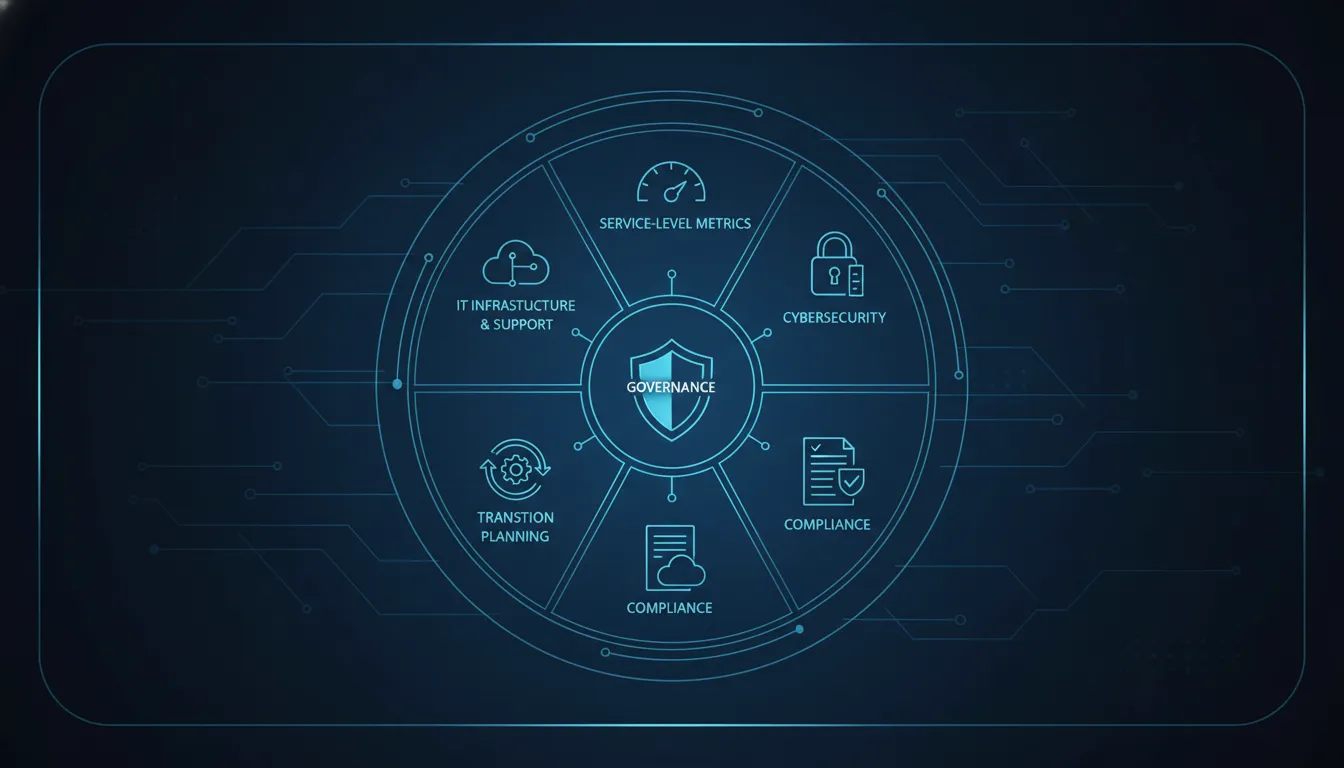
A low-risk transition begins with discovery, dependency mapping, control validation, and explicit ownership. Changes should be sequenced around business criticality, with communication, rollback planning, and executive governance in place. The provider should establish visibility before assuming accountability and stabilize the environment before pursuing major modernization.
Phase one: establish facts and priorities
The provider should inventory assets, systems, integrations, identities, vendors, contracts, and existing controls. It should also identify business-critical workflows and document known risks. This phase creates a shared baseline and prevents assumptions from becoming operational gaps.
Phase two: transfer responsibility safely
Teams should agree on decision rights, escalation procedures, communications, and change windows before responsibilities move. Access changes must follow controlled processes. High-risk findings should be prioritized according to business impact rather than addressed through an indiscriminate remediation backlog.
Phase three: stabilize and improve
Once service is stable, governance should shift toward trend analysis, technical debt, architecture, and investment planning. Early service reviews should confirm whether scope, metrics, and operating interfaces are working as designed. This creates the foundation for continuous improvement rather than an indefinite transition period.
How are managed IT services priced?
Managed IT services are typically priced according to scope, environment complexity, user or asset volume, service coverage, security requirements, and risk. Common structures include per-user, per-device, fixed monthly, consumption-based, or blended models. CIOs should compare total operating value and risk allocation, not only the monthly fee.
Pricing should be transparent enough for the client to understand what drives cost and what could change it. A low initial price may exclude essential capabilities, create high change charges, or depend on narrow assumptions. Conversely, a premium model should demonstrate how its scope, expertise, and governance reduce material risk or improve performance.
Scope and consumption drivers
Key drivers can include locations, endpoints, cloud workloads, applications, service hours, regulatory demands, project needs, and security coverage. Complex legacy systems and fragmented vendor environments may also increase transition and support effort. A discovery process should identify these factors before the provider makes a durable commercial commitment.
Mapping investment to outcomes
Evaluate the commercial model against avoided downtime, reduced exposure, internal hiring constraints, operational consistency, and transformation capacity. Establish baseline measures before the engagement begins. That makes it possible to determine whether the service is producing the intended value rather than merely delivering contracted activity.
Frequently Asked Questions
What is the difference between IT services and managed services?
IT services is a broad category that can include projects, consulting, repairs, and support. Managed services are an ongoing delivery model in which a provider assumes accountability for defined responsibilities and outcomes under a recurring agreement.
Is managed IT better than in-house IT?
Neither model is universally better. Managed IT can improve coverage, specialist depth, and operating consistency. In-house teams retain deep organizational context and direct control. Many mid-market organizations use a co-managed model to combine those strengths.
How do managed IT services work?
The provider assesses the environment, defines scope and service levels, transitions agreed responsibilities, and then delivers continuous operations through monitoring, support, maintenance, security, reporting, and governance.
What are the benefits of managed IT services?
Potential benefits include greater resilience, stronger security execution, predictable operating costs, access to specialized expertise, clearer accountability, and more capacity for internal teams to focus on strategic priorities.
What are examples of managed services?
Examples include service desk operations, cloud management, network monitoring, endpoint management, backup assurance, vulnerability management, Managed Detection and Response (MDR), compliance support, and technology roadmap development.
Build an accountable managed IT operating model
The right partner should strengthen your internal team, make risk visible, and connect daily operations to strategic outcomes. BCS365 delivers managed and co-managed capabilities through a consultative three-phase approach: strategic consultation, seamless startup, and continuous management. Its U.S.-based in-house team supports organizations that need deep technical expertise, architectural rigor, security capability, and transparent service governance.
Schedule a discovery session with BCS365 to evaluate your current operating model and define the capabilities, controls, and outcomes your organization needs next.