
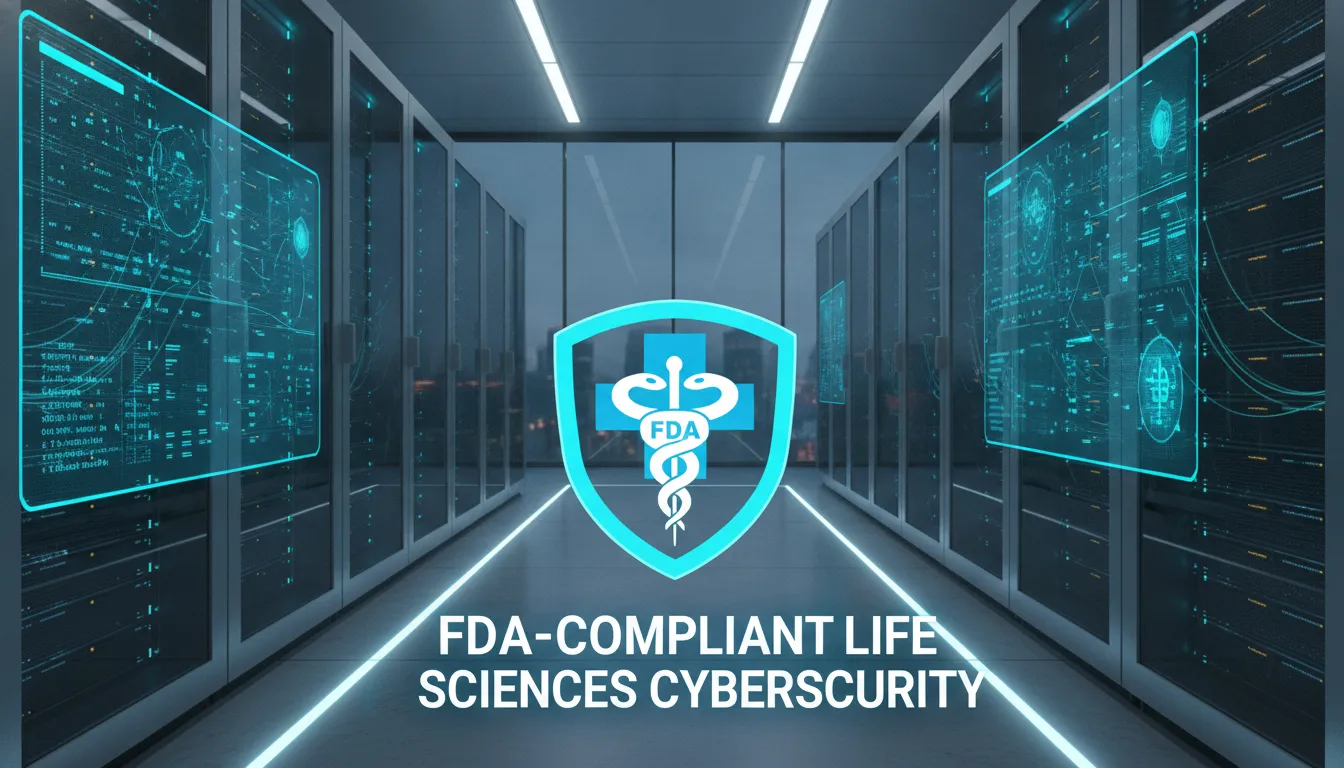
For life sciences and BioTech organizations, cybersecurity is no longer a support function. It is a regulatory requirement woven into the product lifecycle itself. The FDA now mandates that medical device manufacturers demonstrate security by design before receiving clearance. GxP regulations demand continuous data integrity validation across every system that touches product quality. IT Directors and CIOs at mid-market life sciences firms must navigate overlapping mandates from 21 CFR Part 11. The FD&C Act section 524B, and the new Computer Software Assurance (CSA) framework, all while keeping research and production systems operational.
Schedule a Security Risk Assessment today to identify gaps in your FDA cybersecurity and GxP compliance posture before your next audit.
Life sciences cybersecurity is the discipline of protecting regulated systems, patient data. And intellectual property while meeting FDA premarket security requirements, 21 CFR Part 11 electronic record rules, and GxP data integrity standards. As of September 2025, the FDA requires all cyber device submissions to include a Software Bill of Materials (SBOM). A security risk management plan covering the full product lifecycle, and post-market vulnerability monitoring procedures. Non-compliance risks range from Form 483 observations and warning letters to product seizure and criminal referrals. This article provides IT leaders with an architectural framework for building audit-ready, continuously monitored life sciences security programs.
Below, we walk through the regulatory mandates, the architectural controls that satisfy them, and how a specialized partner accelerates compliance without overextending internal teams.
What Does the FDA Cybersecurity Mandate Require for Life Sciences?
The FDA cybersecurity mandate, codified in section 524B of the FD&C Act and supported by the 2023 final guidance on medical device cybersecurity. Requires manufacturers of cyber devices to submit security documentation at premarket filing. This documentation includes a secure design architecture, a Software Bill of Materials (SBOM). Evidence of risk management throughout the product lifecycle, and a plan for coordinated disclosure of post-market vulnerabilities. The Omnibus law passed in late 2022 granted the FDA enforcement authority, and the agency began active review of cybersecurity submissions in March 2023.
The FDA now evaluates cybersecurity as a component of device safety, not a separate IT function. For life sciences firms, this means every medical device, laboratory instrument, or regulated system in the life sciences ecosystem must be designed with security controls from concept through decommissioning.
Defining a cyber device
Under section 524B of the FD&C Act, a "cyber device" meets three criteria: it includes software validated or installed by the manufacturer. It has the ability to connect to the internet, and it contains technology features that could be vulnerable to cybersecurity threats. Most modern life sciences tools, from wearable biosensors to laboratory information management systems (LIMS), fall into this category.
Key regulatory timeline
- Late 2022: Omnibus appropriations bill grants the FDA enforcement authority over medical device cybersecurity.
- March 2023: FDA enforcement authority becomes active; agency releases final premarket cybersecurity guidance.
- September 2023: FDA publishes detailed content requirements for premarket cybersecurity submissions, including SBOM format and security risk management documentation.
- June 2025: FDA updates guidance to include enhanced post-market vulnerability monitoring and coordinated disclosure expectations.
- September 2025: Computer Software Assurance (CSA) framework finalized, replacing legacy CSV for GxP validation.
- February 2026: Quality Management System Regulation (QMSR) aligns with ISO 13485, harmonizing global medical device quality and security requirements.
Penalties for non-compliance
The FDA can issue warning letters, impose import alerts, require product recalls, seize devices, and initiate criminal proceedings against responsible executives for cybersecurity submission failures. These are not theoretical risks. The FDA enforcement framework treats inadequate cybersecurity documentation as a quality system violation under 21 CFR Part 820.
How Do 21 CFR Part 11 and GxP Requirements Shape Data Integrity?
21 CFR Part 11 establishes the FDA criteria under which electronic records and signatures are considered trustworthy, reliable, and equivalent to paper records. The core principles, known as ALCOA+, require that records be attributable, legible, contemporaneous, original, accurate, complete, consistent, enduring, and available. GxP regulations across pharmaceutical development, clinical trials, and medical device manufacturing add validation, audit trail. And access control requirements that make data integrity the foundation of every successful FDA and GxP inspection.
Data integrity failures consistently rank among the most common observations in FDA inspections. When an inspector identifies gaps in audit trails, missing records, or inadequate access controls, the consequences can halt production and delay product approvals. For life sciences IT leaders, building a robust data integrity framework requires understanding three interconnected requirements.
Electronic records and signatures
21 CFR Part 11 requires that electronic records be attributable, legible, contemporaneous, original, and accurate (ALCOA). The ALCOA+ extension adds complete, consistent, enduring, and available. Every user action on a regulated system must be tracked with a secure audit trail that captures old and new values. Systems must prevent or detect unauthorized changes. Without these controls, your regulated data cannot survive an FDA inspection.
Access controls and validation
Part 11 mandates unique user IDs, role-based permissions, and multi-factor authentication for all systems that create, store, or change regulated data. Every computerized system affecting product quality or patient safety must be validated, with documented evidence that the system performs as intended. Published research consistently confirms that validated systems produce more reliable data and pass inspections more readily than unvalidated alternatives.
Inspection risks
When an FDA investigator cannot produce requested records during an on-site inspection, the agency may view this as refusing or limiting the inspection. Observations can escalate from Form 483 to warning letters, import alerts, and consent decrees. Data integrity observations have led to multi-year import bans for several pharmaceutical firms. Maintaining accessible, verifiable records is a business continuity requirement, not merely a compliance checkbox.
Computer Software Assurance: A Risk-Based Approach to Validation
Computer Software Assurance (CSA), finalized by the FDA in September 2025, replaces the traditional Computerized System Validation (CSV) methodology with a risk-based framework. Under CSA, teams focus validation effort on software functions that pose the greatest risk to patient safety and product quality. Rather than scripting exhaustive tests for every system function equally. Low-risk functions can use unscripted testing or vendor-supplied quality documentation. High-risk functions still require full scripted validation. This approach aligns with the new QMSR and ISO 13485 framework effective February 2026.
The shift from CSV to CSA represents a fundamental change in how life sciences organizations approach software validation. For GxP cloud compliance, CSA makes it practical to validate cloud-based systems without the paperwork overhead that previously made cloud adoption prohibitive.
Why the shift to CSA matters
Under legacy CSV, teams spent disproportionate time documenting every test script regardless of risk level. A low-risk reporting function received the same validation rigor as a dose-calculation algorithm. The FDA CSA guidance redirects effort to the controls that actually protect patient safety. For IT Directors, this means shorter validation timelines, reduced documentation burden, and the ability to deploy cloud and SaaS systems faster without increasing regulatory risk.
Applying risk-based validation
The CSA framework asks teams to assess the impact of each software function on product quality and patient safety. Functions whose failure would directly affect patient outcomes require full scripted validation with documented evidence. Functions with indirect or no impact on patient safety can use unscripted testing, which explores the software without predetermined pass or fail criteria. Vendor-supplied quality records, such as ISO 13485 certifications and SOC 2 reports, can substitute for some on-site testing. Managed Detection and Response (MDR) platforms that monitor GxP systems can also benefit from this risk-based approach, focusing continuous monitoring resources on the highest-risk assets.
Building an Audit-Ready Cybersecurity Architecture
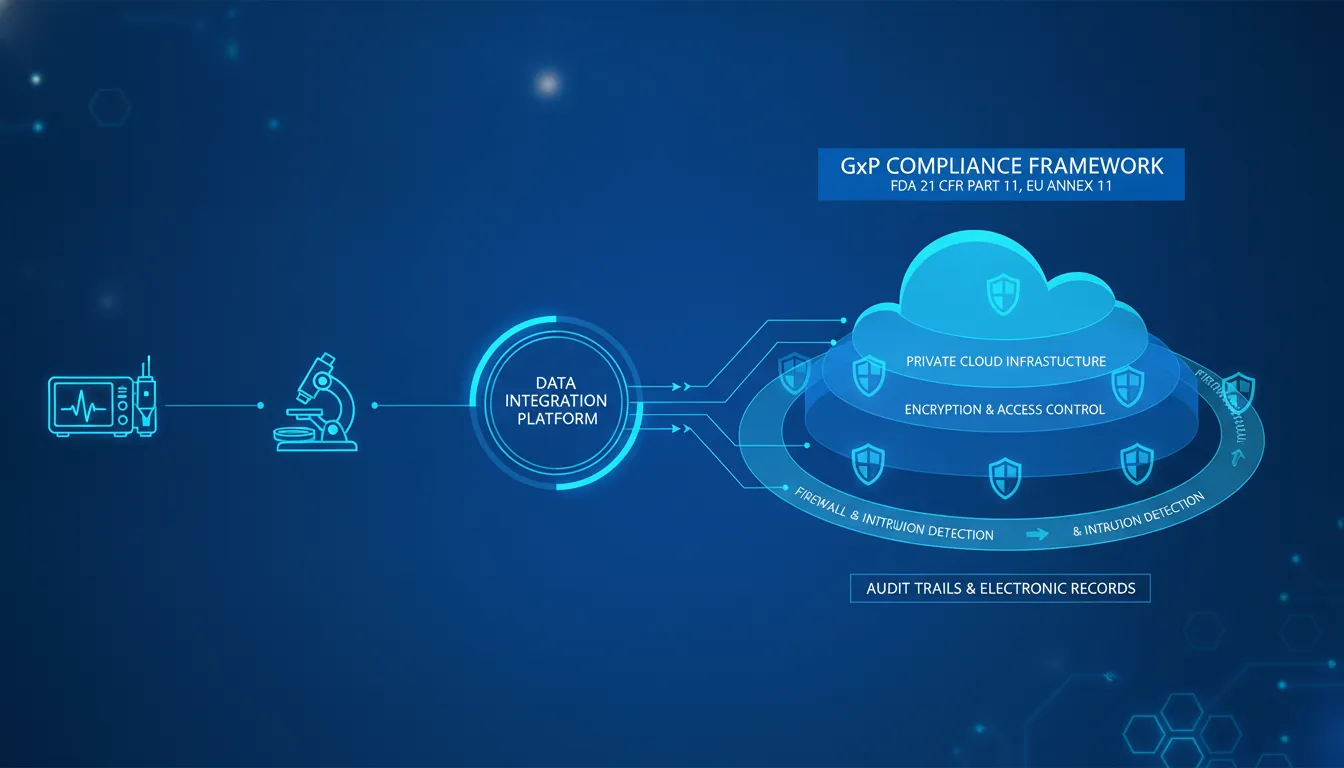
An audit-ready life sciences cybersecurity architecture deploys network segmentation, role-based access controls with MFA, full-disk and in-transit encryption. Automated Software Bill of Materials management, and a continuous monitoring program that feeds into an incident response plan. These controls must be documented with evidence that satisfies both FDA premarket reviewers and on-site GxP inspectors. The cost of retrofitting these controls after an audit finding is significantly higher than building them into the architecture from the start.
FDA inspectors and GxP auditors evaluate evidence that systems are designed with security in mind, not just patched after the fact. Architecture matters because it proves intent. The controls below represent the baseline for any life sciences organization seeking audit readiness.
Network segmentation for GxP systems
GxP systems must operate on separate network segments from general corporate IT traffic. This containment strategy prevents a breach in email or file servers from reaching laboratory information systems, manufacturing execution systems, or quality management platforms. Segmentation with least-privilege firewall rules is the single most effective architectural control for protecting regulated systems.
SBOM and supply chain security
The FDA now expects a Software Bill of Materials in every premarket submission. An SBOM lists every software component, including open-source libraries and third-party SDKs. Automated SBOM tools reduce the manual effort and help teams respond faster when a known vulnerability is disclosed in a library the device uses. For life sciences firms with limited security headcount, managed IT services can operate the SBOM pipeline alongside other compliance workflows.
Access controls and encryption
Multi-factor authentication, unique user IDs, and role-based access control are the minimum standard for any GxP system. Every access event should feed into a centralized logging and alerting platform. Encryption must protect data at rest on servers and endpoints and in transit between systems. The comparison table below maps FDA expectations to GxP requirements and architectural best practices.
| Control Area | FDA Expectation | GxP Requirement | Best Practice |
|---|---|---|---|
| Access Control | Risk management from design phase | Strict audit trails for all user actions | MFA plus RBAC with quarterly access reviews |
| Data Security | Secure device records throughout lifecycle | Full audit trails with before and after values | Encrypt at rest (AES-256) and in transit (TLS 1.3) |
| Network Design | Isolate critical device subsystems | Segregate GxP systems from corporate IT | VLAN segmentation with micro-perimeters |
| Software Supply Chain | SBOM in all premarket submissions | Track all software components in validated systems | Automated SBOM generation with CVE monitoring |
| Testing and Monitoring | Penetration testing before market release | Periodic validation of regulated systems | Annual pen tests plus quarterly vulnerability scans |
What Does Continuous Monitoring Look Like for GxP Systems?
Continuous monitoring for GxP systems combines real-time security event monitoring with automated audit trail review, vulnerability scanning, and structured incident response. The goal is to maintain the validated state of regulated systems between formal revalidation events. For life sciences organizations, this means deploying SIEM platforms on segmented network zones, establishing a risk-prioritized patch management process that accounts for validation constraints. And running tabletop exercises to test incident response plans before a real breach occurs.
Regulatory compliance is not a point-in-time achievement. GxP systems require continuous oversight to maintain their validated state. A single missed patch or unmonitored system can become the weakest link in an inspection.
Continuous monitoring architecture
Effective continuous monitoring for life sciences spans three layers: system-level monitoring (audit trail reviews and configuration drift detection). Network-level monitoring (SIEM correlation, threat intelligence feeds, and IDS or IPS), and application-level monitoring (user behavior analytics and privileged access monitoring). Each layer feeds into a centralized incident response workflow that maps to regulatory notification requirements.
Vulnerability management for validated systems
A vulnerability management program for GxP environments must balance security urgency against validation constraints. Patches affecting validated systems cannot always be applied immediately because revalidation may be required. The program must include asset discovery across all GxP and laboratory systems, regular vulnerability scanning with risk-based prioritization. Coordination with validation teams to schedule patch deployment windows, and verification scans to confirm remediation. Cybersecurity regulations for life sciences increasingly require documented vulnerability management programs as part of GxP compliance evidence.
Incident response planning
Every life sciences firm must maintain an incident response plan that addresses both cybersecurity breaches and regulatory notification requirements. When patient data or product quality is affected, the FDA may require notification. Regular tabletop exercises expose gaps in your plan before a real incident tests them. The following seven-step program establishes a defensible baseline:
- Identify and classify all GxP-relevant systems and data flows.
- Deploy monitoring tools on each segmented network zone.
- Establish a vulnerability scan schedule scanning all critical systems at least monthly.
- Configure automated alerts for anomalies in audit trails and access logs.
- Develop and test incident response playbooks for ransomware, data theft, and system compromise.
- Run penetration tests at least annually and after major system changes.
- Document every step. Audit-ready evidence is the output of continuous monitoring, not a separate exercise.
Why Partner with a Specialized Life Sciences Security Provider?
Mid-market life sciences organizations face a persistent security talent gap, with demand for experienced cybersecurity professionals far exceeding supply. Specialized providers like BCS365 act as force multipliers. Augmenting internal IT teams with deep domain expertise in FDA and GxP compliance without the overhead of building a full in-house security operations center. The combination of continuous monitoring, compliance documentation management. And incident response readiness makes partnerships a practical alternative to expensive internal buildouts, especially for organizations with 300 to 3,000 employees.
Even well-resourced IT teams struggle to maintain the full range of security capabilities required by FDA and GxP mandates. The talent shortage in cybersecurity is especially acute for life sciences, where domain expertise in both security and regulatory compliance is rare.
Closing the security talent gap
Small and mid-market life sciences firms typically cannot compete with large technology companies for senior security talent. Internal IT leaders often end up personally shouldering security responsibilities that would be distributed across a dedicated team at larger organizations. A specialized security partner delivers a full team of FDA and GxP-experienced analysts at a fraction of the cost of building that team internally. BCS365 operates as a force multiplier, augmenting internal IT teams rather than replacing them. Our 100% U.S.-based MDR team uses offensive security methodologies, including real-world attack simulation, to validate defenses continuously.
Accelerating FDA and GxP compliance
Navigating overlapping FDA premarket requirements, 21 CFR Part 11 electronic record rules, and GxP data integrity standards demands specialized experience that most internal teams cannot maintain at depth. A partner who manages life sciences compliance daily brings process maturity, documented evidence templates, and auditor-validated workflows. Our ISO/IEC 27001:2022 certification reinforces the security foundation that supports each compliance domain.
Audit readiness as a continuous state
During an FDA or GxP audit, you must produce organized, verifiable evidence on demand. If your team cannot produce a record when the investigator asks, the agency may interpret that as resistance, escalating the inspection. Specialized partners maintain documentation systems and monitoring evidence in an always-ready state, reducing the pre-audit scramble. MSSP-managed compliance programs structure this evidence gathering as a continuous process rather than a point-in-time project.
Frequently Asked Questions
What are the penalties for non-compliance with FDA cybersecurity requirements?
The FDA can issue warning letters, place devices on import alert, require product recalls, seize devices, and initiate criminal proceedings against responsible executives. Under the FD&C Act, these penalties apply when cybersecurity documentation submitted in premarket filings is found inadequate or when post-market vulnerability monitoring fails to address known risks.
What is the difference between CSV and CSA?
Computerized System Validation (CSV) required scripted testing for every system function regardless of risk. Computer Software Assurance (CSA), finalized by the FDA in September 2025. Allows teams to focus validation effort on high-risk functions while using unscripted testing or vendor-supplied evidence for low-risk functions. CSA reduces validation timelines and documentation burden without compromising patient safety.
Do cloud-based GxP systems require the same validation as on-premise systems?
Yes. Cloud-based GxP systems must meet the same 21 CFR Part 11 and data integrity requirements as on-premise systems. However, the CSA framework makes cloud validation more practical by allowing organizations to rely on vendor certifications (ISO 27001. SOC 2 Type II) for the underlying infrastructure while focusing validation on configuration and integration layers.
How often should GxP systems undergo vulnerability scanning?
The FDA recommends that life sciences organizations scan all GxP-connected systems at least monthly, with critical systems scanned weekly. Annual penetration testing is the minimum standard, with additional testing required after major system changes. Organizations with mature vulnerability management programs typically exceed these minimums.
What is a Software Bill of Materials and why does the FDA require it?
A Software Bill of Materials (SBOM) is a complete inventory of every software component in a medical device or regulated system. Including open-source libraries, third-party SDKs, and their version numbers. The FDA requires SBOMs in premarket submissions to evaluate risks from known vulnerabilities and to facilitate rapid response when new vulnerabilities are disclosed in the software supply chain.
Ready to Strengthen Your Life Sciences Cybersecurity and Compliance Posture?
Meeting FDA cybersecurity requirements and maintaining GxP data integrity across your regulated systems is a continuous operational commitment. BCS365 partners with life sciences and BioTech organizations to design, implement, and monitor security architectures that satisfy both regulatory mandates and real-world threat exposure.
Contact BCS365 today to schedule a Security Risk Assessment and identify gaps in your FDA cybersecurity and GxP compliance program before your next audit.