
Digital transformation consulting is not a technology shopping exercise. For a CIO, CTO, or Director of IT, it is a disciplined way to connect business priorities with architecture, cloud, automation, cybersecurity, and the operating model required to sustain change. The best roadmap does not promise to replace an established IT team. It makes that team more effective, more resilient, and better positioned to deliver measurable business outcomes.
That distinction matters in mid-market and regulated organizations. Legacy platforms, fragmented vendors, audit requirements, and competing modernization projects create more risk than any single outdated application. A transformation roadmap should therefore sequence decisions, establish ownership, and create decision gates before large investments become difficult to reverse.
This guide explains how to build that roadmap, what to measure, and how a digital transformation consulting partner can augment internal expertise without taking accountability away from the people who know the business best.
Schedule a discovery session with BCS365 to map your highest-value modernization priorities to a practical sequence of decisions, controls, and measurable outcomes.
What should digital transformation consulting solve?
Digital transformation consulting should solve the gap between business ambition and the organization's ability to execute change safely. BCS365 approaches that gap by connecting business objectives to an actionable technology blueprint, then aligning architecture, security, delivery, and ongoing operations around the same outcomes.
A roadmap is useful when it answers questions that a list of projects cannot:
- Which business capabilities need to improve, and why now?
- Which constraints, dependencies, and risks could prevent those improvements?
- What should the internal team own, what should a partner augment, and what should be retired?
- How will leadership know that an investment improved resilience, speed, user experience, or financial performance?
Start with business services rather than products. A life sciences organization may need validated systems, reliable research data, and defensible audit evidence. A manufacturer may prioritize uptime, secure plant connectivity, and supply-chain resilience. A financial services firm may focus on identity, data protection, and recovery objectives. The technology decisions follow from those outcomes.
The cost of weak alignment is not theoretical. IBM's Cost of a Data Breach Report documents the material financial impact of breaches and illustrates why modernization decisions must account for operational and security exposure, not only implementation speed.
Summary: A transformation roadmap earns executive support when it translates business risk and opportunity into sequenced capabilities, explicit ownership, and measurable outcomes.
How do you build an enterprise transformation roadmap?
An enterprise transformation roadmap should move through strategy, mobilization, and scale, with a decision gate at each phase. This sequence lets leaders validate value, architecture, risk, and adoption before expanding investment across the organization.
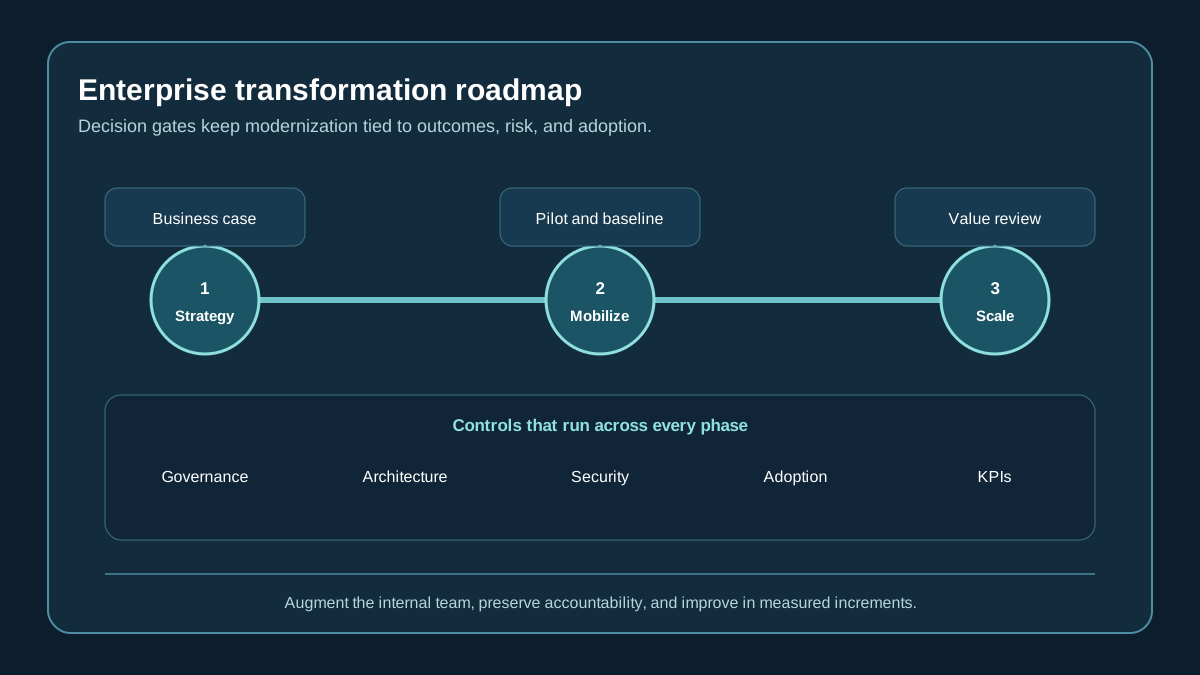
Phase 1: Establish the strategic case
Define the business capabilities that matter most, baseline the current environment, and document the constraints that shape the possible options. Include service owners, finance, security, operations, and the internal IT leaders who will be accountable for delivery.
The output should be a small set of transformation outcomes, such as reducing the time required to provision a business service, improving recovery performance, consolidating duplicated platforms, or increasing the percentage of critical assets covered by current security controls. Avoid vague goals such as "become more digital" or "move everything to the cloud."
Phase 2: Mobilize a controlled pilot
Select a business-relevant use case that is valuable enough to prove the model but bounded enough to control. Establish a baseline before implementation, define acceptance criteria, document the target architecture, and set a rollback path. A pilot may involve a cloud workload, an automated workflow, identity modernization, or an observability improvement.
The pilot is also a test of the operating model. It should reveal whether decision rights are clear, whether teams can obtain reliable data, whether security reviews happen early enough, and whether the organization can support the new capability after the project team leaves.
Phase 3: Scale through repeatable patterns
Scale only after reviewing the pilot against its agreed measures. Turn successful patterns into reference architectures, reusable controls, standard operating procedures, and funding criteria. Retire approaches that did not create value instead of expanding them to protect sunk costs.
Summary: The safest roadmap starts with a business case, proves the delivery model through a controlled pilot, and scales only when evidence shows that value, security, and operational ownership are ready.
Which architecture decisions deserve executive attention?
Executives should focus on architecture decisions that change resilience, risk concentration, cost structure, or the organization's ability to adapt. They do not need to approve every technical detail, but they do need visibility into the decisions that create durable dependencies or affect critical services.
Cloud and workload placement
Cloud adoption should follow workload characteristics and business requirements, not a blanket migration target. Evaluate data sensitivity, latency, availability, recovery objectives, licensing, integration dependencies, and the skills required to operate each workload. A hybrid architecture may be the right answer when regulatory, performance, or operational constraints make a full move impractical.
BCS365's cloud consulting and migration services support this kind of decision by considering Azure, AWS, unified communications, and application requirements as part of the wider operating environment.
Integration and data flow
Modernization often fails when new systems are selected without mapping the data and processes that connect them. Create a dependency map for critical services. Identify the authoritative source for each important data domain, define integration ownership, and establish controls for data quality and access. This reduces the risk of building faster workflows on unreliable information.
Automation and platform engineering
Automate repeatable work where the process is understood and the control points are explicit. Good candidates include provisioning, patching, evidence collection, routine approvals, and service health checks. Do not automate an unclear process simply because a tool makes it possible. Automation should make accountability more visible, not hide it behind a workflow.
Summary: Executive architecture governance should concentrate on workload placement, dependencies, data ownership, automation controls, and the decisions that could create long-term risk or lock-in.
See how BCS365 can augment your internal IT team with 24/7/365 managed operations, infrastructure expertise, and a delivery model designed to preserve internal ownership.
How should cybersecurity and governance shape the roadmap?
Cybersecurity and governance should be design constraints from the beginning of transformation, not approval steps added at the end. Every initiative should identify its data, identities, privileged actions, dependencies, monitoring requirements, and recovery assumptions before implementation begins.
Use a recognized framework to create a common language. The NIST Cybersecurity Framework 2.0 organizes security outcomes around Govern, Identify, Protect, Detect, Respond, and Recover. That structure helps business and technology leaders discuss transformation in terms of risk and outcomes instead of isolated security products.
For identity and access decisions, the NIST Zero Trust Architecture guidance provides a useful reference point: trust should not be assumed simply because a request originates inside a network boundary. Apply least privilege, strong authentication, segmentation, and continuous evaluation in proportion to the service's risk.
Governance should also define who can stop a risky change. A transformation steering group can approve the target state and funding, while architecture, security, and service owners retain authority over technical acceptance criteria. This separation prevents executive urgency from bypassing controls and prevents technical review from becoming an indefinite veto.
BCS365's proactive cybersecurity services connect threat detection, identity security, data protection, vulnerability management, incident response, and compliance support. That integrated view matters because a cloud migration or automation program changes the organization's attack surface at the same time that it changes how work gets done.
Summary: Secure transformation makes governance, identity, data protection, monitoring, response, and recovery part of the design brief, with clear authority to approve or stop risky change.
How do you measure transformation without confusing activity for progress?
Transformation KPIs should measure business capability, risk reduction, service performance, adoption, and financial impact, not the number of projects completed. A dashboard full of migrations, tickets, and workshops can look healthy while critical services remain fragile or employees avoid the new process.
Use a balanced scorecard with a baseline, a target, an owner, and a review cadence for every measure:
- Business outcomes: time to launch a service, cycle time for a critical process, revenue protected, or user experience improvement.
- Reliability: availability of critical services, mean time to detect, mean time to recover, recovery test success, and change failure rate.
- Security: critical asset coverage, remediation time for material findings, privileged access review completion, and incident containment performance.
- Adoption: active use of the new capability, process completion rates, support demand after launch, and feedback from service owners.
- Financial performance: avoided cost, run-cost trend, license utilization, infrastructure unit cost, and benefits realized versus the approved case.
Review metrics by business service rather than only by technology tower. A cloud platform may be healthy while an end-to-end customer workflow remains slow because an integration or approval step was never addressed. Measurement should expose that gap quickly.
Summary: The right KPI set shows whether transformation improved a business service and reduced risk, while also revealing adoption, reliability, and financial performance problems early.
What does a co-managed operating model look like?
A co-managed operating model gives the internal team clear ownership while adding external capacity, specialized expertise, and coverage where internal resources are constrained. It is not a transfer of accountability. It is a deliberate design for how people, processes, technology, and escalation paths work together.
Begin with a responsibility matrix for each service in scope. Define who owns the business outcome, who approves change, who operates the control, who provides subject-matter expertise, and who communicates during an incident. Include after-hours responsibilities rather than assuming that a daytime team can absorb every escalation.
A practical model may use internal leaders for priorities and institutional context, a partner for 24/7/365 monitoring or specialized architecture, and shared governance for risk and service improvement. The arrangement should include shared documentation, common dashboards, regular architecture reviews, and a clear mechanism for bringing knowledge back into the internal team.
BCS365 positions its DevOps consulting and automation capabilities as a complement to internal teams, helping improve delivery pipelines, workflow automation, application integration, and infrastructure resilience. Its managed IT model similarly emphasizes ongoing partnership rather than break-fix support.
The model should be tested during onboarding. Establish a short list of early wins, a service baseline, escalation contacts, access controls, and an acceptance review. BCS365's three-phase approach of strategic consultation, seamless startup, and continuous management provides a useful structure for moving from roadmap to operating rhythm.
Summary: Co-managed IT works when ownership boundaries, escalation paths, documentation, and service measures are explicit, allowing a partner to multiply internal capability without creating ambiguity.
How should leaders control risk during implementation?
Leaders control transformation risk through staged funding, explicit decision rights, reversible pilots, independent security review, and evidence-based go or no-go gates. The purpose is not to eliminate change risk. It is to make risk visible, bounded, and manageable before it reaches critical operations.
| Decision gate | Evidence to review | Typical decision |
|---|---|---|
| Strategic fit | Business case, capability gap, owner, baseline | Fund discovery or stop |
| Architecture readiness | Target design, dependencies, data flows, recovery assumptions | Approve pilot or revise design |
| Security and control readiness | Threat model, identity controls, logging, test plan, rollback path | Authorize controlled change or remediate |
| Operational acceptance | Performance results, adoption evidence, support model, KPI trend | Scale, hold, or retire |
Maintain a decision log that records the reason for each major choice, the assumptions behind it, and the trigger for revisiting it. This helps leadership respond to new information without reopening every prior decision. It also creates useful evidence for audits, post-incident reviews, and future investments.
Summary: Decision gates turn transformation governance into a repeatable control system, allowing leaders to accelerate proven work while stopping weak or unsafe initiatives early.
Schedule a digital transformation roadmap consultation with BCS365 to identify the first controlled modernization opportunity, define ownership, and set the evidence needed for the next decision gate.
Digital Transformation Consulting FAQs
Summary: Digital transformation consulting is most effective when it connects strategy, architecture, security, operating model design, and measurable business outcomes in a controlled sequence.
What is digital transformation consulting?
Digital transformation consulting helps an organization align business goals with changes to its technology, processes, data, security, and operating model. The work typically includes current-state assessment, roadmap design, architecture decisions, implementation governance, and measurement.
How is digital transformation different from an IT upgrade?
An IT upgrade improves a specific system or component. Digital transformation addresses how the organization delivers a business capability end to end, including process design, data flow, user adoption, security, governance, and ongoing operations.
Does digital transformation require moving everything to the cloud?
No. Cloud can improve agility and scalability for the right workloads, but workload placement should reflect business requirements, data sensitivity, performance, recovery objectives, integration dependencies, and operating capabilities. Hybrid and on-premises designs may remain appropriate.
Can a consulting partner work with an established internal IT team?
Yes. A co-managed model can add specialized expertise, 24/7/365 coverage, architecture support, or delivery capacity while the internal team retains business context and strategic ownership. Clear responsibility, escalation, and documentation rules are essential.
What KPIs should a transformation program track?
Track a balanced set of business, reliability, security, adoption, and financial measures. Examples include process cycle time, recovery performance, critical-asset coverage, change failure rate, usage of the new capability, and benefits realized against the approved business case.
How should an organization start a transformation program?
Start by selecting a material business outcome, baselining the current service, documenting constraints, and choosing a bounded pilot. Establish ownership, security requirements, acceptance criteria, and a rollback path before expanding the program.