

Commercial fire alarm systems are life-safety infrastructure, but their operational success depends on more than detectors and a control panel. Facilities, safety, security, and IT leaders need clear ownership for alarms, tested response paths, reliable supporting infrastructure, and carefully governed connections to other building systems. The goal is coordinated operations without compromising the fire alarm system’s approved design or code obligations.
Discuss your facility technology needs
What should commercial fire alarm systems accomplish?
A commercial fire alarm system is intended to detect specified conditions and initiate the responses defined for the building. Depending on the approved design and applicable requirements, that may include local notification, transmission to a supervising station, control of selected building functions, and instructions for staff. The exact functions are site- and jurisdiction-dependent. They should be confirmed with the authority having jurisdiction (AHJ), the building’s fire protection professional, and the parties responsible for ongoing service.
For a multi-site operator, the system is also part of a wider operational environment. A signal may affect evacuation procedures, access to designated areas, continuity plans, security desk activity, and incident documentation. Those connections do not make fire alarm equipment an ordinary IT application. Fire protection design, installation, inspection, testing, and monitoring must remain under qualified parties and follow applicable codes, permits, and manufacturer requirements.
Start by documenting outcomes rather than shopping for features. Identify which conditions must be detected, who receives each alarm, what actions follow, how impairments are reported, and what evidence is retained. Then validate that the proposed system and its interfaces support those outcomes while preserving required independence and reliability.
Organizations with sensitive operations may also need to coordinate fire response with cleanroom access, laboratory procedures, production shutdown sequences, or business continuity plans. These are operational scenarios to review with safety and fire protection specialists; they are not reasons to delay evacuation or override the approved life-safety response.
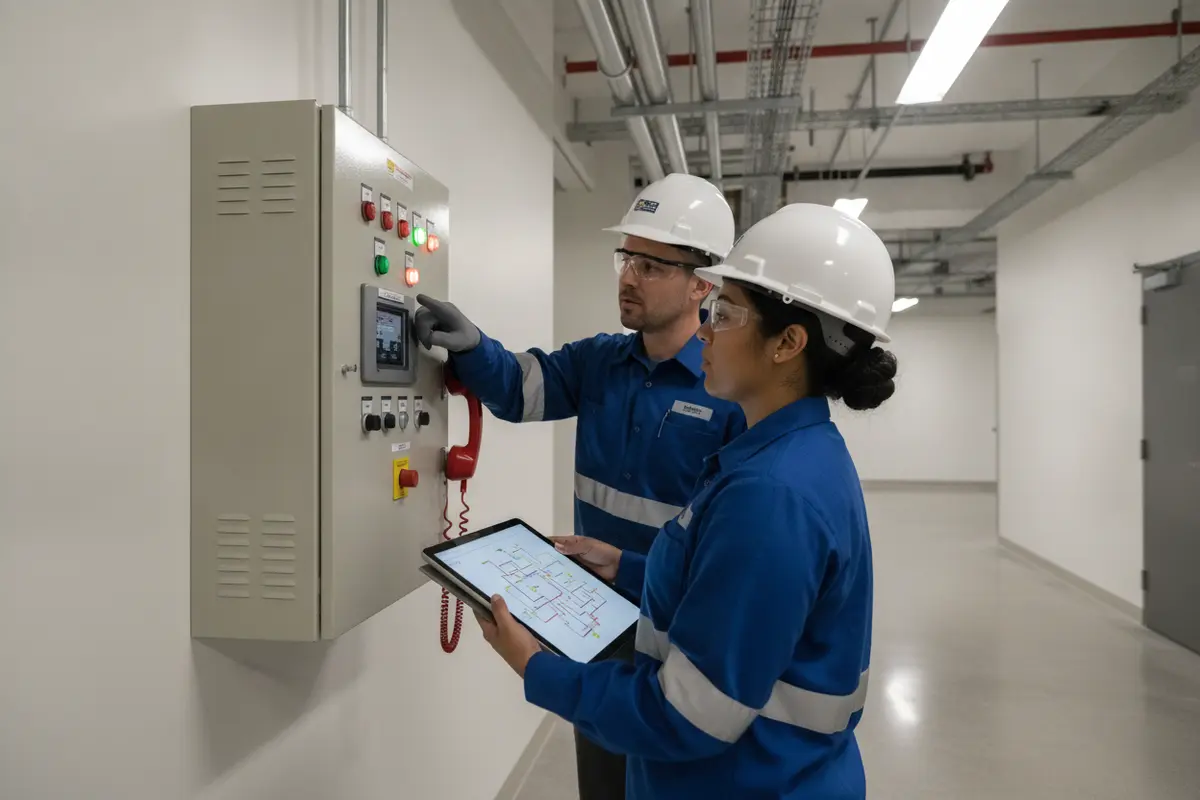
In brief: Define the life-safety outcomes, responsibilities, and response paths first. Technology selection and integration should follow the approved fire protection design.
How do you map requirements across sites?
A single corporate standard can make governance consistent, but it should not assume every building has the same hazards, occupancy, construction, or local requirements. Create a site inventory before specifying upgrades. Include building use, occupancy patterns, operating hours, critical processes, existing system age and condition, monitoring arrangements, planned renovations, and known dependencies on other building technologies.
For each facility, verify source documentation with local owners and qualified specialists. Useful records can include approved drawings, device and panel schedules, inspection and test records, monitoring agreements, impairment procedures, and change history. Flag missing or conflicting records for resolution. Do not assume that a device count or a screenshot from a building platform proves that the installation meets code or is functioning correctly.
- Life-safety scope: Confirm the protected areas, detection and notification objectives, applicable approvals, and responsible fire protection parties.
- Operations: Record the people who acknowledge alarms, the escalation chain, after-hours coverage, and how temporary impairments are communicated.
- Interfaces: Identify any approved connections to access control, building automation, elevators, notification systems, or other equipment. Confirm the purpose and control boundaries for each.
- Technology dependencies: Document power, communications, network paths where applicable, remote access, and monitoring dependencies without treating general-purpose IT controls as substitutes for listed or code-required arrangements.
- Change process: Establish how renovation, tenant changes, network modifications, and equipment replacement are reviewed before work begins.
Standardize the record format and review cadence across sites, while keeping site-specific design and approvals distinct. A central register can show the responsible vendor, last confirmed inspection date, open corrective actions, critical contacts, and document location. Access to sensitive floor plans and security information should be limited to authorized personnel, particularly in regulated facilities.
For a broader view of connected facility components, an organization can map fire alarm dependencies alongside its IT infrastructure and network management responsibilities. This is an ownership and dependency exercise, not a claim that those IT services perform fire alarm inspection or certification.
Make the inventory actionable by separating verified information from assumptions. For example, note when a drawing is missing, when a monitoring contact has not been confirmed, or when the system service provider’s responsibilities are unclear. Assign an owner and next step instead of marking those fields complete based on an old email or an unverified spreadsheet. Review the register when a facility changes use, equipment is modified, or a vendor relationship changes.
Useful portfolio views can group open items by responsible party, site, and dependency, while preserving detailed source records at the facility. Keep emergency response instructions easy to find for authorized responders, but limit access to sensitive diagrams and security details. This balances operational readiness with information governance and avoids placing unnecessary building information in broadly accessible tools.
In brief: Use a common governance record across the portfolio, but validate scope, approvals, and operating conditions at each individual site.
Which integration model fits your operations?
Integration can improve coordination, but each additional interface creates a dependency to document, test, and maintain. The right level is the minimum connection needed to support an approved operational outcome. A fire protection professional should determine what can be connected and how the fire alarm system must behave. IT and facilities teams can help evaluate network boundaries, support ownership, and continuity requirements.
| Operating model | Typical information flow | Operational advantage | Key planning question |
|---|---|---|---|
| Stand-alone with dedicated monitoring | Fire alarm functions remain within their approved system; alarm transmission follows the established monitoring arrangement. | Clear separation of responsibilities and fewer IT dependencies. | Are response contacts, communication paths, and impairment procedures current? |
| Limited status visibility | Authorized teams receive selected status or event information through an approved interface. | Facilities or security staff can coordinate response without changing fire alarm control. | Is the interface permitted, one-way where appropriate, and clearly documented? |
| Coordinated building-system functions | Approved events initiate defined actions in other building equipment or operational workflows. | Can support coordinated site procedures when engineered and tested for the specific facility. | Who validates sequencing, failure behavior, testing, and changes across every connected system? |
| Portfolio-level reporting | Site-level records and selected events are summarized for central oversight. | Improves visibility into ownership, recurring issues, and overdue follow-up. | Does reporting preserve the distinction between informational dashboards and the approved alarm path? |
The table is a planning aid, not a technical design specification. Local code, system listing, manufacturer instructions, and AHJ decisions govern the actual architecture. Avoid making a corporate dashboard the only way to learn of a life-safety event unless that function has been explicitly designed and approved for that purpose.
Network-based research illustrates why real-time fire detection and alarm integration is a distinct engineering topic; it does not establish that any particular network architecture is appropriate for a given building. See the paper, “Network-Based Real-time Integrated Fire Detection and Alarm”, for an example focused on networked fire detection and alarm systems. Apply site-specific engineering and regulatory review rather than importing a research architecture directly into production.
Where physical security systems are part of the operational picture, keep their roles explicit. Fire alarm control and response must not depend on an unrelated access-control or video platform unless the interface is approved and engineered for the required function. Teams can assess surrounding access control and environmental monitoring as separate systems with defined integration boundaries.
For each proposed interface, use a simple decision record: state the operational need, identify the source and destination systems, define whether information is read-only or can trigger an action, name the accountable technical owners, and note the approvals and tests required. Include what happens when the interface is unavailable, how faults are detected, and how a modification will be reviewed. If a purpose cannot be stated clearly, reconsider whether the connection is necessary.
This discipline also helps during procurement. Require vendors to explain supported interfaces and dependencies in writing, identify who maintains each component, and provide the documentation needed for ongoing service. Avoid selecting a system solely because it offers a convenient integration feature; the feature must fit the approved design and be supportable over the expected life of the building system.
In brief: Choose the least complex approved integration that meets a documented need, then assign an owner to test and maintain each interface.
How should teams govern networks and remote access?
Connectivity decisions deserve a written boundary. Establish which system components communicate, which parties administer them, what remote access is necessary, and how changes are approved. Involve the fire alarm service provider and the organization’s IT and security leads before connecting equipment to a business network or enabling remote administration. The design must preserve the fire alarm system’s required operation during failures of other systems.
At minimum, a governance review should ask:
- Is any connection necessary for an approved alarm, monitoring, or reporting function, or is it only convenient?
- Which party owns configuration, credentials, patch coordination, and vendor access? Are responsibilities in writing?
- Can the fire alarm system continue its required local functions if a corporate network, internet connection, or central dashboard is unavailable?
- How is remote access authorized, time-limited where practical, logged, and reviewed? What is the approved process for emergency vendor support?
- Are network changes, maintenance windows, and incident response coordinated so one team does not unknowingly disrupt another’s responsibilities?
- What information can be exported, who may see it, and how are records protected and retained?
Network segmentation and controlled access are useful IT practices, but they do not replace specialist review of the fire alarm system’s listed configuration, communication requirements, or local compliance obligations. Treat a vendor’s request for connectivity as a design input to assess, not automatic authorization. Record the decision, system owner, support path, and test evidence.
For regulated or high-availability operations, include these dependencies in the organization’s wider technology risk review. BCS365’s cybersecurity services and IT consulting pages describe broader technology and security work; neither replaces a licensed fire protection provider or AHJ decision. Likewise, managed IT services can support general IT operations, while fire alarm system duties remain with the parties assigned to that life-safety scope.
It is also important not to conflate cyber monitoring with fire alarm monitoring. Managed Detection and Response (MDR) focuses on cyber threats; it does not replace fire alarm monitoring, emergency notification, or fire protection service. Name the distinct providers and escalation paths in procedures so that an alarm cannot be routed to the wrong queue.
In brief: Treat connectivity, remote access, and support ownership as explicit design decisions, and preserve independent, approved life-safety functions.
What does a reliable alarm response workflow include?
A technically sound system can still produce an operational gap if people do not know what to do when an alarm, trouble condition, or impairment occurs. Build procedures around event types and roles, then verify them with the people who cover each shift and site. Avoid relying on informal knowledge held by one facilities manager or one vendor contact.
- Define event categories. Separate the approved fire alarm response from supervisory, trouble, test, and maintenance notifications as defined for the system. Use the fire protection professional’s terminology and site procedures.
- Name accountable roles. Identify who receives notifications, who directs internal coordination, who contacts the monitoring provider or emergency services when required by the procedure, and who informs leadership.
- Document after-hours coverage. Confirm the contact tree is current, backups are available, and staff know what to do when a primary contact does not respond.
- Set impairment controls. Define how planned maintenance or an unplanned impairment is authorized, communicated, monitored, and returned to service. Follow the applicable fire protection and local requirements.
- Coordinate adjacent systems carefully. Where approved interfaces exist, establish which team verifies the connected action and how conflicts or failures are escalated.
- Capture evidence and close actions. Record tests, notifications, exceptions, corrective work, and sign-off in the appropriate system of record.
Test the workflow with realistic scenarios in coordination with the responsible fire protection professionals and site leadership. For example, ask what happens if the normal monitoring contact is unreachable, if a network link is down, or if a renovation changes room use. A tabletop exercise can expose unclear ownership; it does not replace required inspection, testing, or maintenance.
After a change, confirm who approves the work, who performs the technical test, who accepts the result, and where evidence is stored. This is particularly important during tenant improvements, acquisition integration, or process changes that alter room use and operational dependencies.
After a change, confirm who approves the work, who performs the technical test, who accepts the result, and where evidence is stored. This is particularly important during tenant improvements, acquisition integration, or process changes that alter room use and operational dependencies.
A rollout record should distinguish design approval from commissioning or acceptance evidence, routine service records, and internal operational sign-off. Keep the latest approved documents accessible to the people who need them, with version control so teams do not act on superseded drawings. Record open items with an owner and due date, and document how any temporary condition is managed until closure. These practices help leaders identify locations with unresolved documentation gaps, clarify who owns a planned impairment, and find changes that may have altered an escalation path. They also help prevent a portfolio dashboard from being mistaken for evidence of code compliance.
Before repeating a design at another site, check that occupancy, hazards, layout, operating hours, local approvals, equipment, and monitoring arrangements are comparable. A successful installation at one location is useful evidence about the process, but not automatic approval for another building. Maintain a site-level decision log explaining meaningful differences and the people who accepted the resulting plan.
Review your broader facility technology dependencies
In brief: Specify roles and escalation for each event type, test the human workflow, and preserve formal inspection and maintenance requirements.
How do you plan a safe modernization or multi-site rollout?
Modernization is usually a sequence of site decisions, not a single enterprise-wide equipment swap. Begin with a gap assessment of current documentation, system condition, support arrangements, operational risks, and planned building changes. Ask qualified fire protection professionals to determine code implications and design options. Facilities and IT should contribute dependency maps, change windows, and support requirements.
Use a phased plan:
- Baseline: Confirm the current approved design, monitoring arrangement, service responsibilities, open deficiencies, and site-specific constraints.
- Prioritize: Rank sites using documented condition, operational consequence, project timing, and applicable compliance obligations. Do not use an unsupported universal risk score.
- Design: Agree the system scope and any interfaces with qualified providers and relevant authorities. Define how legacy equipment will be supported during transition.
- Prepare: Schedule work with site operations, safety, IT, security, and vendors. Establish temporary procedures and notification plans before any impairment.
- Validate: Complete required acceptance activities, confirm monitoring and response paths, update drawings and asset records, and train affected teams.
- Operate: Assign recurring owners for tests, maintenance coordination, contact reviews, access reviews, and change control.
For organizations with several locations, pilot the governance model at a representative site before scaling. Select a site that reveals meaningful differences in occupancy or operations, rather than assuming the easiest building proves the model works everywhere. Capture lessons, refine templates, and keep local approval records attached to each site.
Coordinate the rollout with adjacent facility initiatives such as commercial security systems or network changes, but keep separate scopes and acceptance criteria. If a project also includes structured cabling or connectivity work, confirm the responsible team and technical boundary through the network cabling scope. Avoid broad work orders that obscure which vendor is accountable for life-safety system design and approval.
During portfolio review, useful indicators include open corrective actions by site, completion of required service activities, accuracy of emergency contacts, unresolved documentation gaps, and changes awaiting approval. These indicators support management oversight; they should not be presented as a substitute for formal compliance determinations.
In brief: Baseline each site, pilot the governance approach, and scale only after design approval, acceptance, training, and ownership are clear.
Ready to coordinate facility technology responsibly?
Fire alarm systems sit at the intersection of life safety, facilities operations, physical security, and supporting technology. A clear map of systems, interfaces, providers, and response roles helps leaders reduce ambiguity without blurring the specialist responsibilities that protect occupants. If a review identifies broader infrastructure or security dependencies, coordinate those workstreams with the professionals accountable for the fire alarm system.
For a broader conversation about technology planning and operational dependencies, explore the Business Technology Blueprint.
In brief: Keep life-safety design and approval with qualified fire protection professionals, while making cross-team technology ownership visible and testable.
Frequently Asked Questions
In brief: The answers below clarify common planning boundaries for commercial fire alarm systems; site-specific requirements must be confirmed with qualified professionals and the AHJ.
Can a commercial fire alarm system use an organization’s IT network?
That depends on the approved design, equipment, applicable requirements, and the responsible fire protection professionals. Evaluate any connection for necessity, failure behavior, ownership, and security, and obtain the required approvals. A general-purpose network connection should never be assumed acceptable by default.
Should fire alarm events appear in a building or security dashboard?
Selected status information may be useful when an interface is permitted, engineered, and documented. The dashboard should not be treated as the authoritative alarm path unless it has been designed and approved for that role. Confirm which system and provider remain responsible for detection, notification, monitoring, and response.
Who should approve a fire alarm system change?
Approval depends on the scope and jurisdiction. Engage the qualified fire protection professional, system service provider, building owner or designated operator, and AHJ as applicable. IT and security owners should review changes that affect their systems or connections, but that review does not replace fire protection approval.
How often should multi-site teams review alarm response contacts?
Set a documented review cadence that meets applicable requirements and the organization’s procedures, and revisit contacts after staffing, vendor, or site changes. Confirm after-hours coverage and backup escalation paths rather than relying only on a directory update.
Does cyber monitoring replace fire alarm monitoring?
No. Managed Detection and Response (MDR) concerns cyber threats. Fire alarm monitoring and life-safety response have distinct purposes, equipment, responsibilities, and procedures.